

TL;DR #
A residential-scale 10 kW PV system paired with a 10 kWh sodium-ion battery reaches a total lifecycle return of 48,083 yuan versus just 32,468 yuan for the same system without storage — a gap that makes the no-storage configuration economically indefensible at current battery pricing. For buyers sourcing storage-integrated solar systems, this confirms that specifying sodium-ion chemistry at ≤400 yuan/kWh is the threshold where storage-coupled systems outperform storage-free on both total return and payback period. Prioritize suppliers who can document cell-level cost per kWh, round-trip efficiency, and a verified 25-year lifecycle model in their technical proposal.
Overview #
The economics of residential solar-plus-storage have shifted decisively — and any procurement team still treating the storage component as optional is working from an outdated assumption. This analysis draws on a full lifecycle cost-benefit model developed by a provincial macroeconomic research institution, using real irradiation data (1,527 kWh/m² annual total), residential load profiles, and tiered utility tariff structures to evaluate a 10 kW / 10 kWh polysilicon-sodium-ion reference system over a 25-year operational period. The modeled sample spans three installation scales and two storage cost scenarios, giving a statistically grounded view of where the economic breakeven sits — and how sensitive the payback period is to battery unit cost.
What makes this data set useful for procurement is that it removes government subsidy as a variable entirely. Grid feed-in policy changes have stripped out subsidy income for most new residential installations, so the economic case now rests entirely on self-consumption rate, battery round-trip efficiency, and capital cost reduction. Those are exactly the parameters buyers should be interrogating at the supplier level.
The system architecture evaluated here — coupling a polysilicon PV array with a sodium-ion battery pack — is increasingly relevant to buyers sourcing solar generator systems or grid-tied residential BESS products, where chemistry selection directly determines both the initial BOM cost and the long-term revenue model.

Sodium-Ion vs. No-Storage: Lifecycle Financial Performance of Residential PV-BESS Configurations #
This is where the data gets concrete and where most buyers are underestimating the delta.
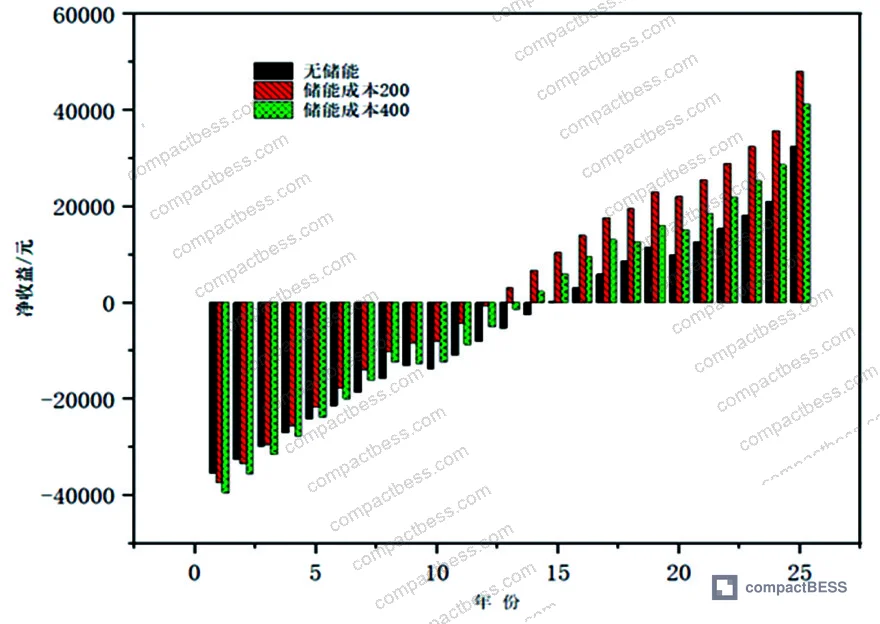
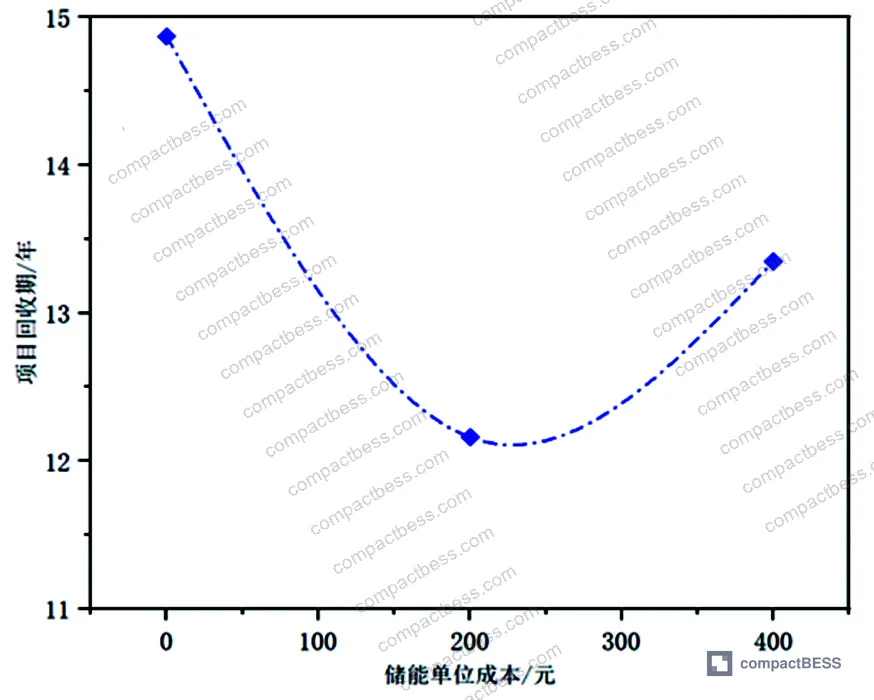
The base case — a 10 kW polysilicon system with no storage — shows a first-year net cash flow of −35,350 yuan and a total lifecycle return of 32,468 yuan over 25 years. Install a 10 kWh sodium-ion battery pack at 400 yuan/kWh, and the first-year net cash flow drops slightly to −39,410 yuan (higher upfront cost), but the lifecycle total climbs to 41,253 yuan. Drop the battery cost to 200 yuan/kWh and the lifecycle return rises further to 48,083 yuan, with a static payback period of 12.16 years versus 14.87 years for the no-storage system.
That is not a marginal improvement. A 48% increase in total return and a 2.7-year reduction in payback period from a single component specification change — battery chemistry and cost tier — is procurement-level information.
| Configuration | First-Year Net Cash Flow (yuan) | Lifecycle Total Return (yuan) | Static Payback Period (years) |
|---|---|---|---|
| 10 kW PV, no storage | −35,350 | 32,468 | 14.87 |
| 10 kW PV + 10 kWh Na-ion @ 400 yuan/kWh | −39,410 | 41,253 | 13.35 |
| 10 kW PV + 10 kWh Na-ion @ 200 yuan/kWh | −37,380 | 48,083 | 12.16 |
The tiered residential tariff structure underlying these numbers runs from 0.3336 yuan/kWh (first tier, 0–1,560 kWh) up to 0.7736 yuan/kWh (fourth tier, above 4,680 kWh). The grid feed-in rate sits at 0.3458 yuan/kWh. The spread between self-consumed electricity value and export value is what makes the storage economics work — self-consumption displaces higher-tier electricity purchases, while export earns only the base feed-in rate.
In supplier qualification, we saw three critical parameters that separate well-engineered sodium-ion packs from underspecified alternatives: discharge efficiency (the model uses 90%), energy conversion efficiency (90%), and charge/discharge depth (90–100%). Suppliers who cannot confirm all three independently — with test data to back it — should not be shortlisted. We’ve reviewed qualification samples where stated efficiency matched spec sheet but actual round-trip efficiency under load dropped to 82–84%, invalidating the financial model assumptions entirely.
Installation Scale and Marginal Return: Where the Economics Plateau #
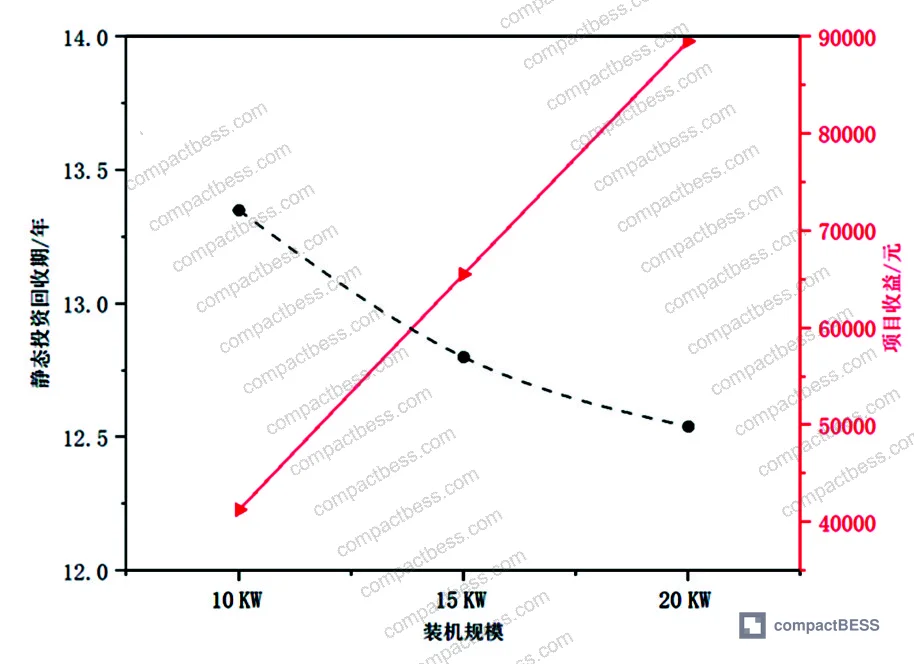
Scaling up from 10 kW to 15 kW to 20 kW with a fixed 10 kWh storage capacity produces meaningful but diminishing returns. The three configurations show initial investment differences of 17,675 yuan between adjacent scale steps. Total project return relative to the 10 kW baseline increases 58.9% at 15 kW and 117% at 20 kW — but the payback period improvement narrows: 15 kW is 0.55 years shorter than 10 kW, while 20 kW is only 0.26 years shorter than 15 kW. Classic diminishing marginal returns.
For buyers specifying systems for residential end-users, this has a direct implication: the 15 kW scale offers the best combination of total return, payback period, and capital accessibility. The 20 kW configuration generates more absolute return, but the incremental payback improvement is too small to justify the additional upfront capital burden on a household budget. All three configurations show payback periods exceeding 12 years, which matters when you’re structuring financing terms or advising clients on system sizing.
Honestly, most buyers over-specify storage capacity relative to PV capacity because they’re matching worst-case load profiles. The model here is instructive — a 10 kWh battery covers daily self-use of 11 kWh against a household demand of roughly 4,500 kWh/year, with surplus exported to the grid. Oversizing the battery beyond 10 kWh in this scenario would increase capital cost without proportional return improvement, because the self-consumption ceiling is already met.
The full system investment breakdown for the 10 kW / 10 kWh reference configuration is: PV initial investment 35,000 yuan, PV maintenance 8,750 yuan, PV replacement cost 8,000 yuan; storage initial investment 4,000 yuan, storage maintenance 1,500 yuan, storage replacement cost 8,000 yuan; total lifecycle investment 65,250 yuan. PV accounts for 67.67% of initial investment, storage adds 11.43% to initial capital but doubles the replacement cost line — which means battery longevity and replacement cycle specification directly affect lifecycle economics.
The model assumes inverter replacement twice, combiner box replacement once, metering device replacement once, and battery pack replacement twice over 25 years. PV module residual value at end-of-life is recovered at 40% of initial price; other equipment follows standard accounting depreciation.
This lifecycle replacement cadence is exactly why cycle life and degradation specifications on the battery pack matter so much — a pack that degrades faster than the model assumes will require an earlier replacement cycle, shifting the payback curve unfavorably.
Sodium-Ion Chemistry Selection: Why This Battery Specification Matters for BESS Sourcing #
The choice of sodium-ion over lithium-ion in this model isn’t arbitrary — it reflects a deliberate cost and safety tradeoff that procurement teams sourcing BESS products need to understand.
Sodium-ion cells offer lower material cost (no lithium, cobalt, or nickel dependency), inherently safer thermal behavior, and sufficient cycle life for residential applications. The reference system specifies a unit cost of 400 yuan/kWh at time of modeling, with the sensitivity analysis showing that 200 yuan/kWh — an achievable target given current trajectory — dramatically improves the financial case.
Most procurement teams don’t realize that sodium-ion battery specifications are still being standardized across different testing frameworks. IEC 62619:2022 Safety requirements for secondary lithium cells and batteries provides the closest applicable safety framework for sodium-ion packs in stationary applications, even though the standard name references lithium. Buyers sourcing sodium-ion BESS should explicitly confirm with suppliers which standard their cells are tested against and whether abuse testing covers the relevant failure modes for this chemistry.
For system-level safety validation, UL 9540A Test Method for Evaluating Thermal Runaway Fire Propagation in Battery Energy Storage Systems is the relevant benchmark for any product entering North American markets. The thermal runaway propagation behavior of sodium-ion chemistries differs from NMC and LFP, and some suppliers have not completed cell-level characterization for this test protocol — which is a disqualifying gap for buyers with US market exposure.
Transport certification is a parallel requirement. UN 38.3 Recommendations on the Transport of Dangerous Goods — Lithium Battery Testing applies to sodium-ion cells for air and sea freight classification purposes, and documentation gaps here create customs clearance delays that can collapse project timelines.
The annual PV output figure of 12,200 kWh for a 10 kW system under Yunnan conditions (1,527 kWh/m² irradiation, 80% system efficiency, 0.45% annual panel degradation) gives buyers a benchmark for validating system design claims from suppliers serving similar climate zones.
Practical Guidance for Buyers #
The financial data here gives you a concrete negotiating position. At 400 yuan/kWh for sodium-ion storage, the system economics already outperform no-storage configurations on total return — even with a slightly longer payback period in the sensitivity band. If a supplier quotes you storage at above 400 yuan/kWh and cannot justify the premium with demonstrably better cycle life or efficiency, that’s a pricing problem, not a specification upgrade.
When evaluating proposals, focus on three parameters that the model shows are economically sensitive: round-trip efficiency (90% is the validated threshold), charge/discharge depth capability (90–100%), and battery replacement cycle (two replacements over 25 years is the baseline assumption). A pack that degrades to the replacement threshold earlier than modeled will shift your payback period by 1–2 years — which matters when you’re presenting ROI to end customers.
Buyers sourcing for Southeast Asian or Southwest Chinese residential markets should apply this framework directly. Buyers for European or Middle Eastern markets will need to adjust the feed-in tariff and self-consumption rate assumptions, but the battery specification logic translates cleanly. For protection circuit design requirements specific to grid-tied BESS, the BMS specification will need to address grid disconnection, anti-islanding, and depth-of-discharge management simultaneously.
At compactbess.com, our sourcing team works with verified Chinese manufacturers of battery packs and integrated BESS modules — connecting OEM buyers and energy system integrators with suppliers who can document efficiency, cycle life, and certification status before RFQ. If your project requires matching a specific cost-per-kWh target or cycle life guarantee, we can narrow the supplier list before you commit engineering resources to sample evaluation.
Need help identifying qualified suppliers for sodium-ion or LFP battery packs for solar-storage integration? Talk to our sourcing team →
Supplier Qualification Questions #
- What is your sodium-ion (or LFP) cell’s measured round-trip energy efficiency under a standard 0.5C charge / 0.5C discharge cycle at 25°C, and can you provide third-party test data confirming ≥90% round-trip efficiency?
- What is the rated charge/discharge depth of your battery module, and does your BMS enforce a maximum depth-of-discharge limit to protect cycle life — specifically, can it operate at 90–100% DoD as specified in residential BESS configurations?
- What is your documented battery unit cost per kWh at current production volumes, and at what volume threshold can you reach ≤400 yuan/kWh (or equivalent USD/EUR pricing) with consistent specification?
- What is your cell’s rated cycle life at 80% capacity retention, and how does replacement cadence align with a 25-year system lifecycle requiring no more than two battery pack replacements?
- Has your battery pack been tested under IEC 62619:2022 or equivalent standard, and can you provide abuse test reports (overcharge, short circuit, thermal exposure) specific to the sodium-ion chemistry — not re-used lithium-ion test data?
Sourcing Checklist #
- ☐ Supplier confirms round-trip efficiency ≥90% with test data at 0.5C/0.5C under standard conditions (25°C, per IEC 62619 or equivalent)
- ☐ Battery unit cost per kWh is documented at ≤400 yuan/kWh (or market equivalent) with volume and lead time stated
- ☐ Charge/discharge depth rated at 90–100% DoD with BMS enforcement confirmed in system documentation
- ☐ Cycle life rated for ≥2,000 full cycles at 80% capacity retention, supporting two replacement cycles within a 25-year system life
- ☐ Annual PV system output model validated against local irradiation data (reference: 1,527 kWh/m² for Class II solar resource zone), with system efficiency assumption ≥80%
- ☐ Inverter replacement schedule documented (2× over 25 years), and inverter spec is compatible with battery pack charge/discharge profile
- ☐ UN 38.3 transport certification present for cell-level shipment (required for air/sea freight to international markets)
- ☐ Supplier can provide lifecycle cost model (initial investment + O&M + replacement + decommissioning) showing static payback period calculation methodology
Key Specifications Table #
| Parameter | Recommended Value | Verification Method |
|---|---|---|
| Battery unit cost (sodium-ion) | ≤400 yuan/kWh (economic threshold); target ≤200 yuan/kWh for optimized return | Supplier quotation + BOM cost breakdown; compare against published market indices |
| Round-trip energy efficiency | ≥90% | Third-party discharge test at 0.5C charge / 0.5C discharge, 25°C; per IEC 62619 test protocol |
| Charge/discharge depth (DoD) | 90–100% | BMS parameter readout; confirmed under simulated daily cycle at rated load |
| Annual PV system output (10 kW, Class II solar zone) | ≥12,200 kWh/year (first year, 80% system efficiency) | On-site irradiation data cross-referenced with 1,527 kWh/m² reference; inverter yield log |
| Static payback period (10 kW / 10 kWh system, 400 yuan/kWh storage) | ≤13.35 years | Lifecycle financial model with local tariff data, feed-in rate, and replacement cost schedule |
| Battery discharge efficiency | ≥90% | Load bank test at rated discharge current; verified by supplier or third-party lab |
Can’t find a supplier meeting these specs? Submit your requirements and we’ll match you within 48 hours.
References #
Data source: Economic Viability of Household Distributed Photovoltaic-Storage Systems Under Subsidy-Free Grid Conditions: A Lifecycle Cost-Benefit Analysis, D.-R. Hu et al., Energy Storage Materials, 2025
Frequently Asked Questions #
Does adding a battery storage system always improve the economics of a residential solar installation?
Based on the lifecycle model evaluated here, yes — at current sodium-ion pricing of 400 yuan/kWh, a 10 kWh battery increases total 25-year project return from 32,468 yuan to 41,253 yuan while reducing the static payback period from 14.87 years to 13.35 years. The crossover point where storage-free systems might still make sense has already passed given current battery cost trajectories.
What is the optimal installation scale for a household PV-storage system, and why?
The 15 kW scale shows the best balance across total return, payback period, and capital accessibility. Compared to 10 kW, it delivers 58.9% higher total return and a 0.55-year shorter payback. Moving to 20 kW only reduces payback by a further 0.26 years while requiring significantly more upfront capital — diminishing returns that make the jump difficult to justify for most residential users.
Why is sodium-ion specified instead of lithium iron phosphate (LFP) for this type of application?
Sodium-ion offers lower raw material cost, no dependency on lithium or cobalt supply chains, and sufficient safety characteristics for residential stationary use. At the 400 yuan/kWh cost point modeled here, sodium-ion is competitive with LFP on economics while offering potential long-term cost advantages as production scales. That said, buyers should verify that their target chemistry has completed relevant abuse testing — not all sodium-ion suppliers have done so against current standards.
How sensitive is the payback period to battery cost, and what’s the buyer implication?
Very sensitive. Dropping storage cost from 400 yuan/kWh to 200 yuan/kWh shortens the payback period from 13.35 years to 12.16 years and increases total lifecycle return by 16.6% (from 41,253 to 48,083 yuan). This means negotiating battery unit cost is the single highest-leverage procurement action for improving project economics — more impactful than optimizing installation scale within the ranges modeled.
What certifications should buyers require for sodium-ion battery packs used in grid-tied residential BESS?
At minimum: IEC 62619:2022 for electrochemical safety, UN 38.3 for transport classification, and UL 9540A if the product is destined for North American markets. EU-bound products will additionally require compliance with EU Battery Regulation 2023/1542 for lifecycle and traceability documentation. Request abuse test reports specific to sodium-ion chemistry — do not accept lithium-ion test data as a substitute.
Published by compactbess.com Technical Team | Request a sourcing quote


