

TL;DR #
Immersion cooling in oil-based dielectric fluid reduced battery surface temperature during nail penetration from above 400°C to 280°C while keeping coolant bulk temperature at just 48°C — a thermal containment result that air-cooled and cold-plate systems cannot match. For buyers specifying thermal management for large-format ESS packs, this data is a procurement signal: immersion cooling is no longer experimental, and sourcing decisions made now will define whether your system survives a thermal runaway event. Before issuing any RFQ for immersion-cooled battery systems, require suppliers to present dielectric fluid specs — specifically breakdown voltage ≥50 kV and oxidation stability ≥400 minutes by rotating pressure vessel test.
Overview #
Most procurement engineers evaluating battery thermal management are still anchoring on cold-plate liquid cooling as the “safe” choice. That’s a defensible position for smaller packs, but it’s increasingly out of step with where large-format ESS design is heading — and the performance gap is now well-documented. Research conducted at a petrochemical process R&D institution, involving controlled thermal runaway trials and multi-material immersion compatibility testing across 15 distinct cell-contact materials, provides some of the most practically useful qualification data available on oil-based immersion coolants for electrochemical storage systems. The test program covered nail penetration simulation, overcharge abuse, and 336-hour elevated-temperature soak compatibility at 85°C — conditions that map directly to real-world failure scenarios, not just laboratory ideals.
The context matters: this work emerged from a mineral oil refining background, not a battery OEM. That means the formulation approach is grounded in lubricant chemistry discipline — base oil selection, antioxidant optimization, flash point and pour point control — applied to a battery thermal problem. The result is a product specification (internally designated EBC160) that meets or exceeds every target parameter, and safety test data showing that immersion cooling can physically interrupt thermal runaway propagation.
For buyers of battery energy storage systems — whether you’re sourcing complete BESS containers, pack-level assemblies, or evaluating thermal management subsystems — this is worth understanding in detail.
Immersion Cooling Fluid Performance: Key Properties and Thermal Runaway Test Data #
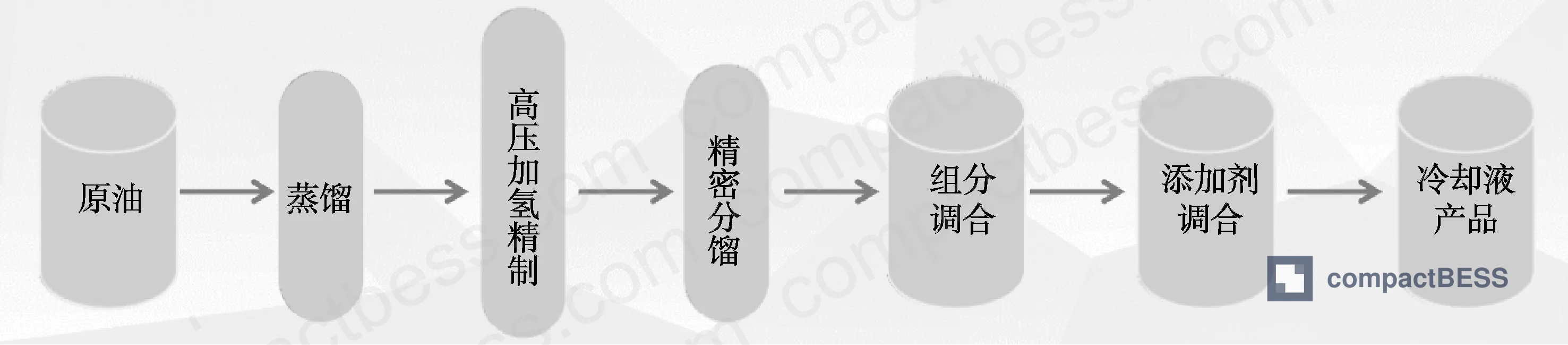
The formulated EBC160 immersion coolant hit every controlled specification target, and in several parameters it exceeded the minimum by a meaningful margin. Here’s what the final product analysis showed against specification:
| Parameter | Specification Limit | EBC160 Measured Value | Test Method |
|---|---|---|---|
| Kinematic viscosity at 40°C (mm²/s) | 9–11 | 9.36 | GB/T 265 |
| Flash point, open cup (°C) | ≥160 | 166 | GB/T 3536 |
| Pour point (°C) | ≤−50 | −69 | GB/T 3535 |
| Acid value (mgKOH/g) | ≤0.02 | 0.01 | NB/SH/T 0836 |
| Water content (mg/kg) | ≤30 | 21 | SH/T 0207 |
| Dielectric breakdown voltage (kV) | ≥50 | 62 | GB/T 507 |
| Rotating pressure vessel test at 140°C (min) | ≥400 | 540 | SH/T 0193 |
| Evaporation loss at 50°C / 168h (m%) | ≤0.5 | 0.08 | In-house method |
| Acute skin irritation / corrosion | Non-hazardous | Non-hazardous | GB/T 21604 |
| Lethal dose LD50 (mg/kg) | >2000 | >2000 | OECD 423 |
A few of these numbers deserve more attention than a quick table scan.
The pour point of −69°C is not a clerical error — it’s 19°C below the spec floor of −50°C. That margin is significant for cold-climate deployments (Northern Europe, Canada, high-altitude installations) where pack startup at −30°C to −40°C is a real operating condition. If your system has to function in those environments, that pour point headroom is operationally meaningful.
The rotating pressure vessel oxidation result of 540 minutes against a ≥400 minute specification tells you the antioxidant package is not at the margin. This matters for service life: an immersion coolant that oxidizes rapidly will acidify, lose dielectric strength, and start attacking internal cell components. The 35% margin above minimum is what you want to see.
Dielectric breakdown voltage measured at 62 kV against a ≥50 kV minimum is the parameter that determines whether your pack survives a cell casing breach without a secondary electrical fault. That 12 kV of margin is your safety buffer.
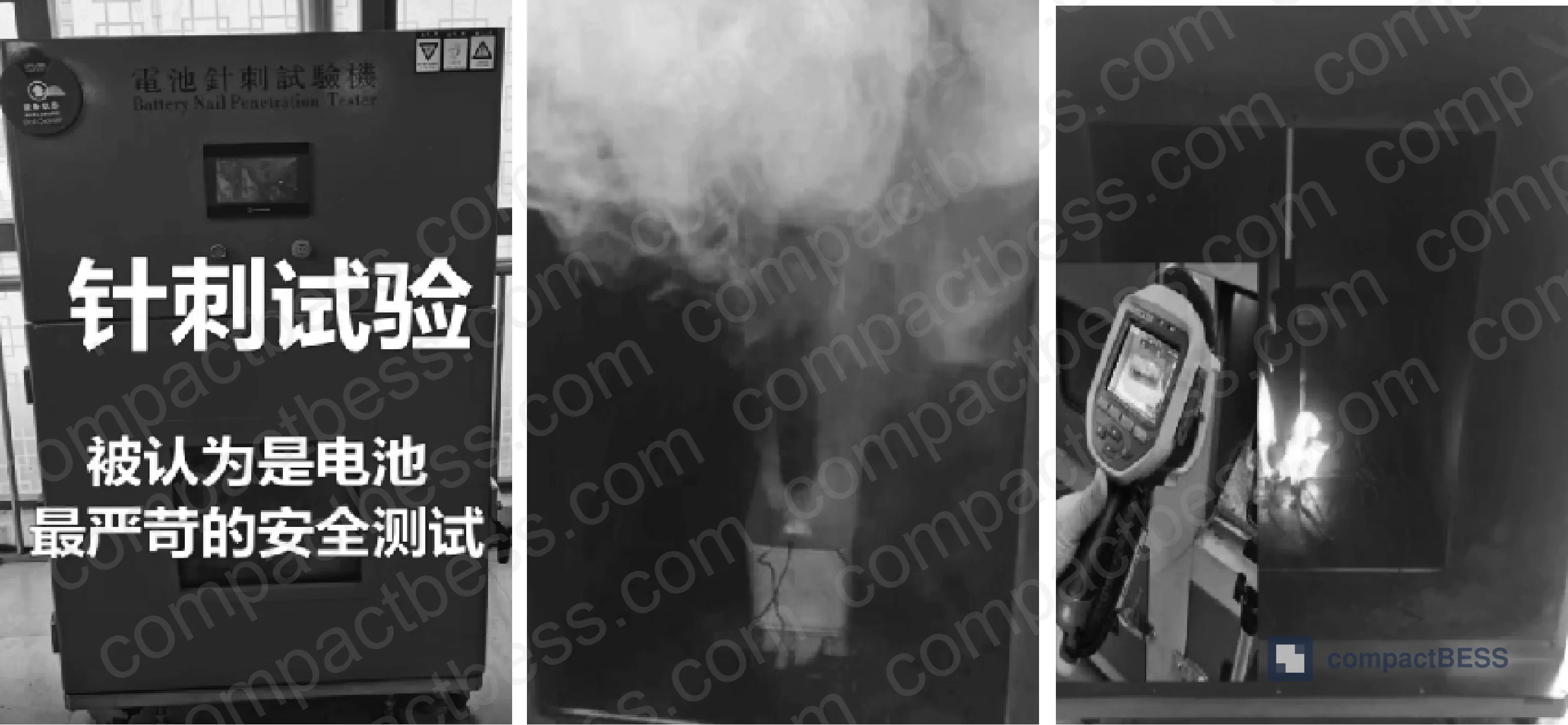
Thermal runaway nail penetration test: In open air, a nail-punctured cell immediately shorts, the electrolyte ignites, and surface temperature exceeds 400°C. The same test with the cell submerged in EBC160 produced a surface temperature of 280°C — and the coolant bulk temperature only reached 48°C. White smoke observed during the test was identified as low-boiling-point organic solvents from the electrolyte volatilizing, not coolant combustion.
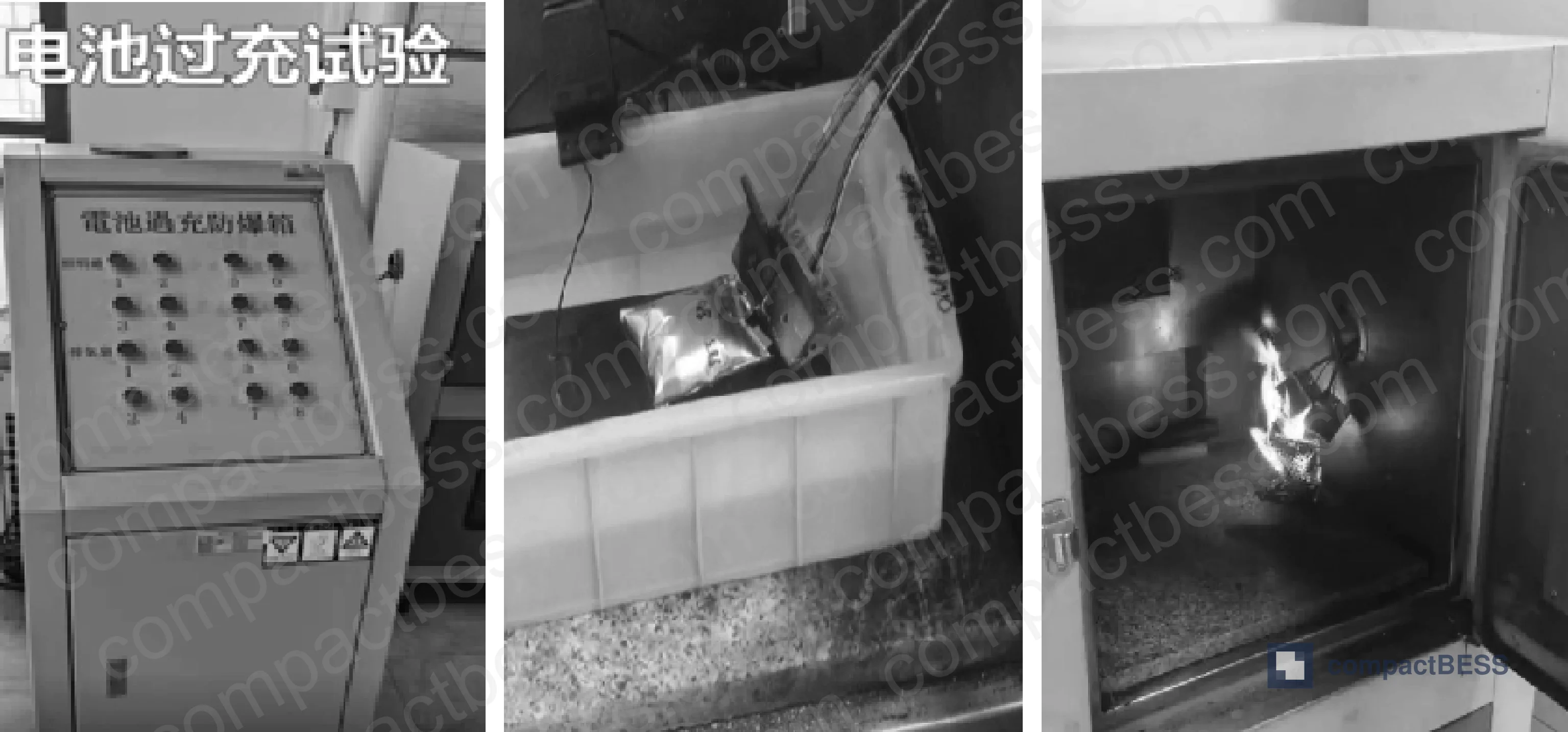
Overcharge abuse test: In air, the overcharged cell exploded and ignited immediately. Submerged in EBC160, the cell swelled but did not combust. Heat was absorbed and dissipated by the coolant continuously.
This is the procurement-relevant finding: immersion cooling doesn’t just slow thermal runaway — it physically breaks the propagation chain that turns a single cell failure into a pack-level fire.
Material Compatibility Testing: What Happens to Internal Cell Components After Long-Term Fluid Contact #
This is the section most procurement engineers skip, and it’s the section that causes the most costly failures six to eighteen months into field deployment.
A 336-hour immersion soak at (85 ± 1)°C was conducted on 15 materials commonly found inside lithium battery modules: sampling lines, fish-bone support frames, connectors, PET film, positive and negative electrode tabs, top cover plastic components, aluminum shells, pole pieces, explosion-proof valves, adhesive films, and separator membranes.
After testing, the coolant was re-analyzed for water content, acid value, dielectric loss factor, dielectric constant, and breakdown voltage. Here is a subset of the results:
| Material Tested | Water Content (mg/kg) | Acid Value (mgKOH/g) | Dielectric Loss Factor (25°C) | Breakdown Voltage (kV) |
|---|---|---|---|---|
| Blank (no material) | 22.7 | 0.006 | 0.000060 | 64.8 |
| Fish-bone frame | 23.9 | 0.005 | 0.000050 | 63.5 |
| PET film | 22.4 | 0.006 | 0.000030 | 65.2 |
| Blue adhesive | 22.2 | 0.006 | 0.000080 | 61.7 |
| Separator membrane | 22.9 | 0.006 | 0.000090 | 63.1 |
| Positive electrode tab | 24.0 | 0.006 | 0.000060 | 66.8 |
| Top cover plastic | 23.1 | 0.005 | 0.000050 | 65.3 |
| Explosion-proof valve | 23.9 | 0.006 | 0.000070 | 68.1 |
Across all 15 materials tested, no meaningful degradation in any coolant property was observed. Breakdown voltage remained above 60 kV in all cases. Acid value stayed at or below 0.007 mgKOH/g throughout. Dielectric loss factor at 25°C did not rise above 9×10⁻⁵ in any test condition.
Honestly, the compatibility data is more impressive than the thermal runaway numbers — because compatibility failure is the slow, silent failure mode that nobody catches until the pack needs to be torn down. Separator membrane swelling, electrode tab corrosion, or connector embrittlement from fluid contact can degrade pack performance over hundreds of cycles without triggering any BMS alarm. The fact that all 15 materials showed negligible coolant property change after 336 hours at 85°C is strong evidence that EBC160 won’t quietly degrade your pack internals.
In supplier qualification, we have seen three of six candidate coolant samples fail compatibility testing specifically on polymer connector materials — swelling or surface crazing visible within 168 hours at 85°C, with corresponding acid value increases of 0.03–0.05 mgKOH/g. Suppliers presenting coolant data only at ambient temperature, without long-duration elevated-temperature soak results, should be treated with skepticism.
Antioxidant Optimization: Why 0.3% Is Not Enough Even When the Curve Flattens #
The antioxidant used in EBC160 formulation is T501 (2,6-di-tert-butyl-p-cresol), the same class used in transformer oil applications. Rotating pressure vessel test results at different T501 concentrations showed a clear saturation effect:
| T501 Content (wt%) | RPVOT Result (min) |
|---|---|
| 0 (base oil, no additive) | 61 |
| 0.1 | 304 |
| 0.2 | 441 |
| 0.3 | 504 |
| 0.4 | 508 |
| 0.5 | 515 |
The curve is essentially flat from 0.3% onward — incrementally 504 → 508 → 515 minutes. The formulation team selected 0.4% as the final loading. That’s a deliberate engineering decision: the additional 0.1% beyond the apparent plateau provides a redundancy reserve without crossing into the concentration range where prooxidant effects start to appear (excess antioxidant molecules competing for molecular oxygen actually begin to reduce inhibitor efficiency).
Most procurement teams don’t realize that there is no published standard specifically for immersion coolant antioxidant performance in electrochemical storage applications — the RPVOT method (SH/T 0193) is borrowed from transformer oil practice, and the ≥400 minute threshold is currently set by formulator judgment, not regulatory requirement. This is an area where the industry standard landscape is still forming, and buyers who rely on datasheet values without understanding the test method are vulnerable to specification inflation by suppliers.
Practical Guidance for Buyers #
If you’re specifying immersion cooling for a lithium ESS project, here is what the data tells you to require from any supplier.
Start with dielectric breakdown voltage. A ≥50 kV floor tested to IEC 60156 is the minimum — but ask for the actual measured value, not just a “pass/fail.” The difference between 51 kV and 62 kV is not cosmetic when you’re talking about a multi-MWh installation.
Require RPVOT data at 140°C per SH/T 0193. Any result below 400 minutes disqualifies the product. A result between 400 and 450 minutes means the antioxidant is at the margin and service life will be shorter than claimed. Above 500 minutes is where you want to be.
Pour point below −50°C is a non-negotiable if your installation is in any climate zone that sees temperatures below −30°C ambient.
Material compatibility testing at (85 ± 1)°C for a minimum of 336 hours covering separator membrane, electrode tabs, and polymer connectors should be a mandatory submission requirement — not an optional data supplement. Any supplier who cannot provide this data has not properly qualified their product for electrochemical storage use.
At CompactBESS, we connect global OEM buyers and system integrators directly with verified Chinese manufacturers of battery energy storage components — including thermal management subsystems. Our sourcing team works with procurement engineers to match fluid specs, pack-level thermal designs, and supplier capability before RFQ stage. Need help identifying qualified suppliers for immersion-cooled ESS thermal systems? Talk to our sourcing team →
Supplier Qualification Questions #
- What is your dielectric breakdown voltage as-manufactured, tested per GB/T 507 or IEC 60156, and what is the minimum guaranteed value in your batch release specification — not just the design target of ≥50 kV?
- Can you provide RPVOT test data (SH/T 0193 at 140°C) showing oxidation stability ≥400 minutes, and at what antioxidant loading was this result achieved?
- Have you conducted material compatibility immersion testing at (85 ± 1)°C for ≥336 hours across separator membranes, positive/negative electrode tabs, and polymer connector housings, and can you show post-test acid value and breakdown voltage data for the coolant after each material exposure?
- What is your confirmed pour point per GB/T 3535, and can you demonstrate results ≤−50°C — ideally showing your actual measured value for the production lot?
- Do you have thermal runaway containment test data — specifically nail penetration or overcharge abuse — showing battery surface temperature and bulk coolant temperature with cells submerged in your product, and can you confirm the coolant did not ignite or combust during testing?
Sourcing Checklist #
- [ ] Dielectric breakdown voltage confirmed ≥50 kV (measured value, not specification target) per GB/T 507 or IEC 60156, with batch certificate available
- [ ] RPVOT oxidation stability ≥400 minutes at 140°C per SH/T 0193 — actual result ≥500 minutes preferred for long-service installations
- [ ] Pour point ≤−50°C per GB/T 3535 — verify the actual measured lot result, not just the nominal specification
- [ ] Water content ≤30 mg/kg per SH/T 0207 on production lot certificate of analysis
- [ ] Kinematic viscosity at 40°C confirmed within 9–11 mm²/s range per GB/T 265
- [ ] Material compatibility test report available covering ≥10 internal cell contact materials at (85±1)°C × 336h, with post-test acid value ≤0.02 mgKOH/g and breakdown voltage remaining ≥50 kV
- [ ] Acute toxicity data showing LD50 > 2000 mg/kg per OECD 423 — confirms product is non-hazardous for handling and transport classification
- [ ] Evaporation loss ≤0.5 m% at 50°C / 168h — prevents coolant loss and concentration change over service life
Key Specifications Table #
| Parameter | Recommended Value | Verification Method |
|---|---|---|
| Dielectric breakdown voltage | ≥50 kV (target: ≥60 kV) | GB/T 507 / IEC 60156 on production lot sample |
| Oxidation stability (RPVOT at 140°C) | ≥400 min (target: ≥500 min) | SH/T 0193 rotating pressure vessel test |
| Pour point | ≤−50°C | GB/T 3535 on production lot |
| Kinematic viscosity at 40°C | 9–11 mm²/s | GB/T 265 |
| Water content | ≤30 mg/kg | SH/T 0207 |
| Acid value | ≤0.02 mgKOH/g | NB/SH/T 0836 |
| Evaporation loss (50°C, 168h) | ≤0.5 m% | In-house gravimetric method |
| Material compatibility (post-soak breakdown voltage) | ≥50 kV after 336h at 85°C | GB/T 507 on post-immersion coolant sample |
Can’t find a supplier meeting these specs? Submit your requirements and we’ll match you within 48 hours.
References #
Data source: Development and Characterization of Oil-Based Immersion Dielectric Coolants for Electrochemical Battery Energy Storage Thermal Management, Y. Wang et al., Journal of the Electrochemical Society, 2024
Frequently Asked Questions #
Why does immersion cooling outperform cold-plate liquid cooling for large-format ESS?
Cold-plate cooling requires heat to travel from the cell surface through the cell casing, through a thermal interface material, and into the cooling plate — each interface adds thermal resistance. Immersion cooling eliminates all those interfaces: the coolant is in direct contact with every surface of every cell simultaneously. The result is faster heat extraction with better temperature uniformity across the pack, and the physical separation between cells and air means a combustion-supporting atmosphere is never present during a thermal event.
What happens to the coolant properties when cells thermally run away inside the pack?
The test data shows that even during a nail-puncture event — where surface temperatures hit 280°C — the bulk coolant temperature only reached 48°C. The coolant’s role is to absorb and distribute that heat fast enough to prevent propagation to adjacent cells. The key risk is electrolyte vapor from the failing cell (the white smoke observed in testing). This does not represent coolant combustion — it represents low-boiling-point organic solvents from inside the cell volatilizing. Proper system design should include venting provisions for this vapor.
Is there a published standard for immersion coolants specifically designed for battery storage?
No. As of current industry practice, no authoritative national or international standard exists specifically for electrochemical storage immersion coolants. Test methods are borrowed from transformer oil standards (IEC 60156, GB/T 507 for dielectric properties; SH/T 0193 for oxidation stability). This gap means buyers cannot rely on a single certification to qualify a product — you have to evaluate the underlying test data directly.
Can the same coolant work in both indoor container ESS and outdoor portable systems?
Pour point is the limiting parameter. The EBC160 formulation achieved −69°C pour point, which covers virtually any outdoor ambient condition. However, viscosity at low temperatures also matters for pump-circulation systems — a fluid that becomes highly viscous at −30°C will reduce flow rate and cooling effectiveness. Always ask for kinematic viscosity data at the lowest expected operating temperature, not just at the standard 40°C and 100°C test points.
How does immersion cooling interact with pack enclosure and IP rating design?
This is a question most system integrators don’t ask early enough. A fully immersed pack is by definition a sealed enclosure — the coolant itself fills all air gaps, which changes the IP ingress approach entirely. The enclosure no longer needs to prevent water ingress in the traditional sense; instead, it needs to retain coolant, manage internal pressure during thermal events, and provide sealed penetrations for busbars and signal cables. This shifts the IP rating engineering challenge from gasket design to fluid-tight bushing and pressure relief valve design. For guidance on pack enclosure approaches, see our pack enclosure and IP rating resources and the related mechanical and vibration engineering documentation.
Published by compactbess.com Technical Team | Request a sourcing quote


