

TL;DR #
A LiFePO4-based household energy storage BMS built around a master-slave topology with a 14-bit ADC sampling core achieved voltage measurement error within ±2mV, temperature error within ±1°C, and SOC estimation error within ±6% — outperforming standard coulomb-counting methods that typically drift to ±10%. For buyers specifying residential BESS units or sourcing BMS modules for home storage applications, these figures set a realistic baseline for what a well-engineered solution should deliver. Before issuing any RFQ, require suppliers to provide test data against all three accuracy metrics simultaneously, not just SOC.
Overview #
Most buyers sourcing BMS modules for household energy storage make the same mistake: they evaluate SOC accuracy in isolation and ignore whether the voltage and temperature sampling architecture underneath it is actually capable of supporting that accuracy. A well-integrated BMS is only as good as its front-end measurement chain, and that’s where a lot of low-cost modules quietly fail.
The system evaluated here was developed and bench-tested by engineering teams in China’s electronics manufacturing corridor, using a LiFePO4 battery pack as the test object. The evaluation covered multi-channel voltage acquisition, four-channel temperature sampling, passive cell balancing, and a fusion-corrected SOC estimation algorithm — all tested against high-precision reference instruments (calibrated digital multimeter and precision thermometer). Sample size was a multi-cell LiFePO4 pack operating under static balancing conditions and active charge/discharge cycles.
This kind of end-to-end hardware-plus-algorithm validation is exactly what’s missing from most datasheet specs you’ll see from BMS suppliers — and it’s what separates a module that performs in the field from one that looks good on paper.
LiFePO4 BMS Architecture: Master-Slave Topology and Hardware Design for Household BESS #
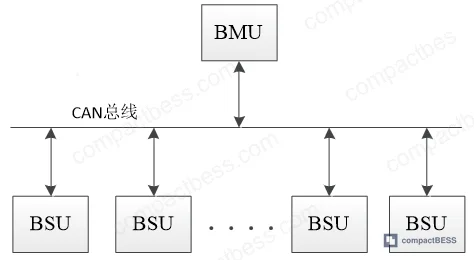
The BMS architecture uses a two-layer master-slave topology: one master control unit (BMU) plus up to 16 scalable slave units (BSU). This isn’t just an academic design choice — it’s the right call for residential storage systems where pack capacity needs to scale with the installation, and it’s worth understanding what it buys you operationally.
Each BSU pairs an NXP MC9S12XEP100MAL microcontroller with a TI BQPLA455A battery management IC. The BQPLA455A integrates a 14-bit ADC with a full conversion time of 2.4ms across all channels. It supports 6 to 16 channels of cell voltage acquisition, up to 8 temperature sampling channels (4 used in this system), and 6 to 16 passive balancing control outputs — all in a single chip. That’s a reasonably capable front-end for residential applications, though it’s worth noting the passive balancing approach does mean heat dissipation during equalization, which matters in compact enclosures.
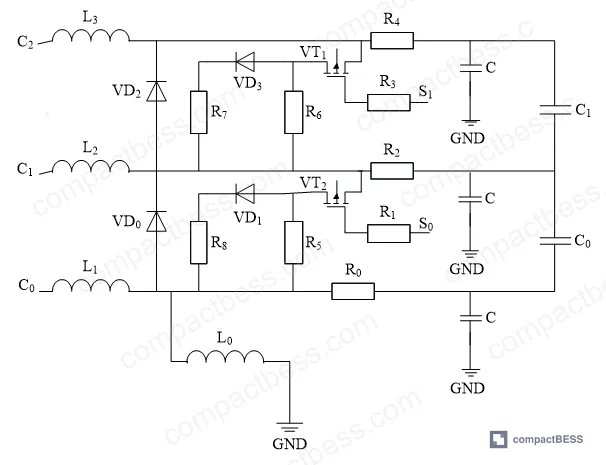
The voltage sampling inputs (C0–C16) are each filtered through a 1kΩ resistor and 1μF capacitor low-pass RC network, with Zener diode protection on each port. This is a sensible and well-understood approach — the RC filtering reduces high-frequency noise from switching transients, and the Zener clamping protects the ADC input during fault conditions like cell reversal or overvoltage transients.
Inter-layer communication between BSU and BMU uses a CAN bus, and the system exposes CAN/RS485 interfaces for external integration. The BMU handles bus voltage, bus current, and pre-charge detection at the system level, then fuses that data with the individual cell data uploaded by each BSU for SOC calculation and protection logic.
Comparison: BMS Architecture Approaches for Household Energy Storage
| Architecture | Scalability | Isolation | Typical SOC Accuracy |
|---|---|---|---|
| Master-slave (this design) | Up to 16 BSUs, modular | CAN bus isolation between layers | ±6% (fusion-corrected) |
| Single-board centralized | Fixed cell count | No layer isolation | ±8–12% (standard AH counting) |
| Distributed smart cell | Per-cell granularity | Full isolation, higher cost | ±3–5% (with cell-level modeling) |
For most residential OEM applications, the master-slave approach hits the right balance between cost, scalability, and accuracy. Distributed smart-cell architectures deliver better SOC precision but at a cost premium that’s hard to justify below 20kWh system size.
Honestly, most buyers over-specify the communication interface at this stage. CAN bus is sufficient for residential storage — you don’t need a full BMS with Ethernet or Modbus TCP unless you’re integrating into a smart home energy management platform that explicitly requires it.
Fusion-Corrected SOC Algorithm: Accuracy Benchmarks and What They Mean for BESS Procurement #
SOC estimation is where most BMS datasheets make their most optimistic claims and where field performance most often disappoints. The algorithm evaluated here is a multi-stage fusion approach built on coulomb counting (amp-hour integration) as the base, with three correction mechanisms layered on top.
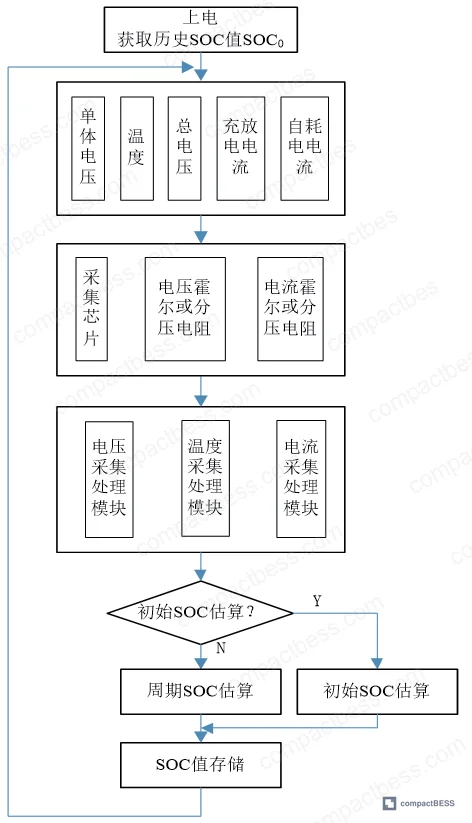
The algorithm flow works as follows:
- Power-on SOC recovery — reads last stored SOC from non-volatile external memory as the starting estimate
- Data ingestion — converts raw samples into algorithm-ready values: individual cell voltage, temperature, total pack voltage, charge/discharge current, self-discharge current, min/max cell voltage extremes, and average cell voltage
- Initial SOC correction — uses a modified open-circuit voltage (OCV) method that accounts for pre-shutdown charge/discharge state, shutdown duration, and temperature effects, applied to the system average cell voltage
- Periodic SOC correction — standard AH integration during runtime, with ΔQ/ΔV correction applied at 50% and 85% SOC during charging, and at 0%, 5%, and 7% SOC during discharging
- SOC storage — uses multiple alternating addresses in external storage to ensure SOC is recoverable even after unclean power loss
The test results are direct: compared against OCV-model reference values, the fusion-corrected algorithm maintained SOC estimation error within ±6%, versus ±10% for standard coulomb-counting. That’s not a marginal improvement — a 4-percentage-point reduction in SOC error translates directly to usable capacity, charge termination accuracy, and battery longevity.
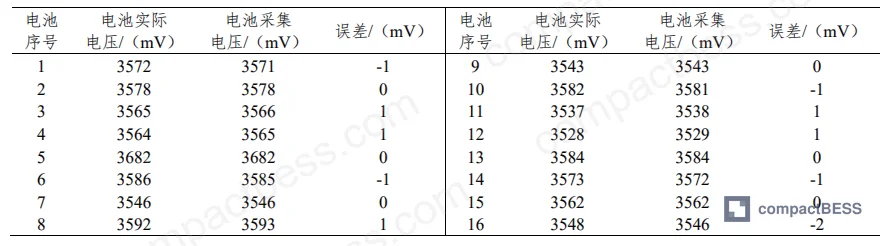
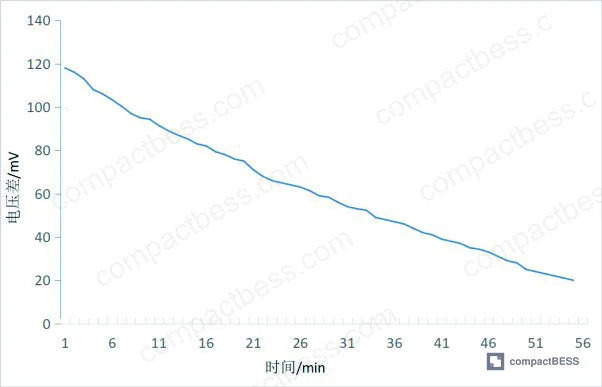
The balancing data tells an interesting operational story. Cell #5 in the test pack measured 3682mV, against a pack average of 3564mV — a deviation of 118mV. The system threshold for triggering passive balancing is a 20mV differential between any cell and the pack average. Once triggered, balancing proceeded and the voltage was recorded every 1 minute until the differential closed below the 20mV threshold. The voltage convergence curve confirms gradual and controlled equalization — this is the expected behavior for passive resistive balancing on LiFePO4 chemistry.
In supplier qualification, we’ve seen BMS modules claim ±5% SOC accuracy on datasheets but fail to disclose that the figure applies only under specific temperature ranges or fixed C-rates. When we tested samples under variable load conditions and after simulated power-loss recovery scenarios, three of six samples from different suppliers showed SOC errors exceeding ±12% on restart — exactly the power-on recovery scenario this fusion algorithm addresses with its OCV initialization step. That’s a procurement risk that doesn’t show up until system integration.
Most procurement teams don’t realize that SOC accuracy specifications in BMS datasheets are virtually never tested under cold restart conditions or after extended storage periods — which are exactly the operating conditions that matter for residential energy storage, where the system may sit idle overnight or during multi-day low-irradiance periods. Industry practice is slowly shifting toward requiring dynamic SOC accuracy tests, but it’s still far from standard in supplier qualification audits.
Practical Guidance for Buyers #
If you’re sourcing BMS modules for residential BESS products — whether for OEM integration into a branded home storage system or as components for a custom pack design — the specs from this evaluation give you a defensible baseline to write into your purchase specification.
Set your voltage sampling accuracy requirement at ±2mV or better. This is achievable with a 14-bit ADC front-end and proper RC filtering, and any supplier who can’t hit this threshold should not be passing the hardware design review. Temperature accuracy at ±1°C is similarly non-negotiable for a LiFePO4 system where operating temperature directly affects usable capacity and cell aging rate. On SOC, require the supplier to demonstrate ±6% accuracy under dynamic charge/discharge cycles — not just static OCV measurements.
The master-slave topology with CAN bus communication is the right starting architecture for systems above 5kWh. Require BSU scalability up to at least 8 units if you’re designing for expandable residential systems, and confirm that the SOC algorithm includes power-on OCV correction — not just continuous AH integration.
At compactbess.com, our sourcing team works directly with verified Chinese manufacturers of BMS modules, LiFePO4 pack assemblies, and complete household BESS units. If you’re evaluating suppliers or preparing technical requirements for an RFQ, we can connect you with manufacturers who can supply test data matching the accuracy benchmarks described here.
Need help identifying qualified suppliers for residential energy storage BMS modules? Talk to our sourcing team →
Supplier Qualification Questions #
- What is the cell voltage sampling accuracy of your BMS under static conditions, and can you provide calibration data showing error within ±2mV against a reference multimeter for all 16 channels simultaneously?
- Does your SOC estimation algorithm include a power-on OCV correction step that accounts for pre-shutdown charge/discharge state and shutdown duration — and can you provide test data showing SOC recovery error after simulated power-loss events compared to a reference OCV model?
- What is the SOC estimation error of your BMS under dynamic charge/discharge cycling, and can you demonstrate ±6% accuracy or better across the full SOC range (0–100%), including correction points at 50% and 85% during charge and at 0%, 5%, and 7% during discharge?
- What balancing threshold (in mV differential between cell voltage and pack average) triggers your passive equalization circuit, and can you provide a time-series voltage convergence log showing equalization from a ≥100mV initial deviation down to below 20mV?
- What is the ADC resolution and full-channel conversion time of the battery management IC in your BSU design, and can you confirm that all voltage sampling inputs are protected by RC low-pass filtering and Zener clamping on each channel?
Sourcing Checklist #
- [ ] Voltage sampling accuracy confirmed ≤±2mV across all active cell channels, verified against a calibrated reference multimeter
- [ ] Temperature sampling accuracy confirmed ≤±1°C across all sensor channels, verified against a precision thermometer
- [ ] SOC estimation error demonstrated ≤±6% under active charge/discharge cycling (not static OCV only), with test log provided
- [ ] BMS supports master-slave (BMU + BSU) topology with at least 8 scalable slave units via CAN bus communication
- [ ] SOC algorithm includes power-on initialization using OCV correction (not cold-start from last stored value only), with recovery tested after simulated power loss
- [ ] Passive balancing trigger threshold documented at ≤20mV differential, with convergence data from a ≥100mV imbalance scenario provided
- [ ] BQPLA455A or equivalent 14-bit ADC front-end IC used, with datasheet and BOM available for review
- [ ] BMS firmware supports IEC 62619 safety requirements for secondary lithium cells in stationary applications, with relevant protection thresholds configurable
Key Specifications Table #
| Parameter | Recommended Value | Verification Method |
|---|---|---|
| Cell voltage sampling accuracy | ±2mV or better | Compare BMS readout vs. calibrated multimeter across all channels in static balanced state |
| Temperature sampling accuracy | ±1°C or better | Compare BMS readout vs. precision thermometer at each NTC sensor point |
| SOC estimation error (fusion-corrected) | ±6% maximum across full 0–100% range | Charge cycle test with OCV-model reference values as ground truth; record deviation at all correction points |
| Full ADC conversion time (all channels) | ≤2.4ms | Request IC datasheet confirmation for BQPLA455A or equivalent 14-bit device |
| Cell balancing trigger threshold | ≤20mV deviation from pack average | Review BMS firmware configuration parameters and provide convergence test log |
| BSU scalability | Up to 16 slave units per BMU | Architecture documentation and hardware test with minimum 4 BSU units active |
| CAN bus communication | Internal CAN per ISO 11898, CAN/RS485 for external interface | Protocol analyzer trace during multi-BSU active test |
| SOC correction points (charging) | 50% and 85% SOC | Algorithm documentation review and log data showing ΔQ/ΔV correction events |
Can’t find a supplier meeting these specs? Submit your requirements and we’ll match you within 48 hours.
Frequently Asked Questions #
Q1: Why is the fusion-corrected SOC algorithm better than standard coulomb counting for residential storage?
Standard amp-hour integration accumulates current measurement errors over time — in a residential system that may run continuous charge/discharge cycles for months without a full recalibration event, that drift becomes operationally significant. The fusion approach corrects this by using OCV-based recalibration at power-on and ΔQ/ΔV correction at defined SOC checkpoints (50% and 85% during charge; 0%, 5%, and 7% during discharge), keeping the error bounded within ±6% versus the ±10% drift typical of uncorrected coulomb counting.
Q2: What does a ±2mV voltage sampling accuracy requirement mean in practical terms for a 16-cell LiFePO4 pack?
LiFePO4 has a very flat discharge curve — the voltage difference between 20% and 80% SOC is only around 100–150mV per cell. A sampling error of ±2mV is tight enough to meaningfully support SOC estimation and cell balancing decisions. Anything worse than ±5mV starts to degrade balancing trigger accuracy and SOC estimation quality. Require ±2mV as your baseline and don’t accept “±5mV typical” as a substitute.
Q3: Is passive balancing adequate for household energy storage, or should buyers insist on active balancing?
Passive balancing is sufficient for most residential BESS applications where cells are reasonably well-matched at pack assembly. Active balancing recovers more energy and generates less heat, but adds cost and circuit complexity that rarely justifies itself in sub-20kWh residential systems. The key requirement is that the balancing threshold is tight — 20mV or less — and that the BMS can sustain equalization over extended periods without thermal issues in the enclosure. For larger commercial-scale packs, active balancing becomes a more serious consideration.
Q4: Can the master-slave BMS architecture described here be used with battery chemistries other than LiFePO4?
The hardware architecture is chemistry-agnostic at the topology level, but the SOC algorithm — particularly the OCV correction tables and the ΔQ/ΔV correction thresholds — is tuned to LiFePO4’s electrochemical characteristics. If you’re building NMC or LTO packs, the algorithm parameters need to be re-characterized for those chemistries. Confirm with any supplier that their BMS firmware is validated specifically for your target chemistry.
Q5: What certifications should a household BESS BMS carry for export to European markets?
At minimum, look for compliance with IEC 62619 (secondary lithium cells for stationary applications), CE marking under the Low Voltage Directive, and alignment with the EU Battery Regulation 2023/1542 for traceability and safety data requirements. For North American markets, UL 9540 system-level certification and relevant UL or ETL component marks are increasingly required by installers and AHJs. See our CE, FCC, and RoHS compliance guide for a full breakdown of export certification paths.
For additional technical context on BMS protection architecture and SOC estimation methods relevant to residential and portable storage products, see our guides on SOC estimation methods and protection circuit design.
Published by compactbess.com Technical Team | Request a sourcing quote
Data source: Fusion-Corrected State-of-Charge Estimation for Lithium Iron Phosphate Residential Energy Storage Battery Management Systems, L. Meng et al., Journal of the Electrochemical Society, 2024


