

TL;DR #
A pouch-format lithium-sulfur cell measuring 97 mm × 120 mm × 9 mm achieves 350 W·h/kg at the cell level and 250 W·h/kg at the module level — roughly 40–60% higher gravimetric energy density than equivalent NMC or LFP modules. For buyers evaluating next-generation cell formats for high-energy applications, this gap is large enough to justify a separate qualification track even if cycle life remains a constraint. Before issuing any RFQ for high-energy pouch modules, confirm that the supplier’s structural design applies a controlled preload of 600–800 N between cells, as this directly governs cycle stability in lithium-sulfur and lithium-metal systems.
Overview #
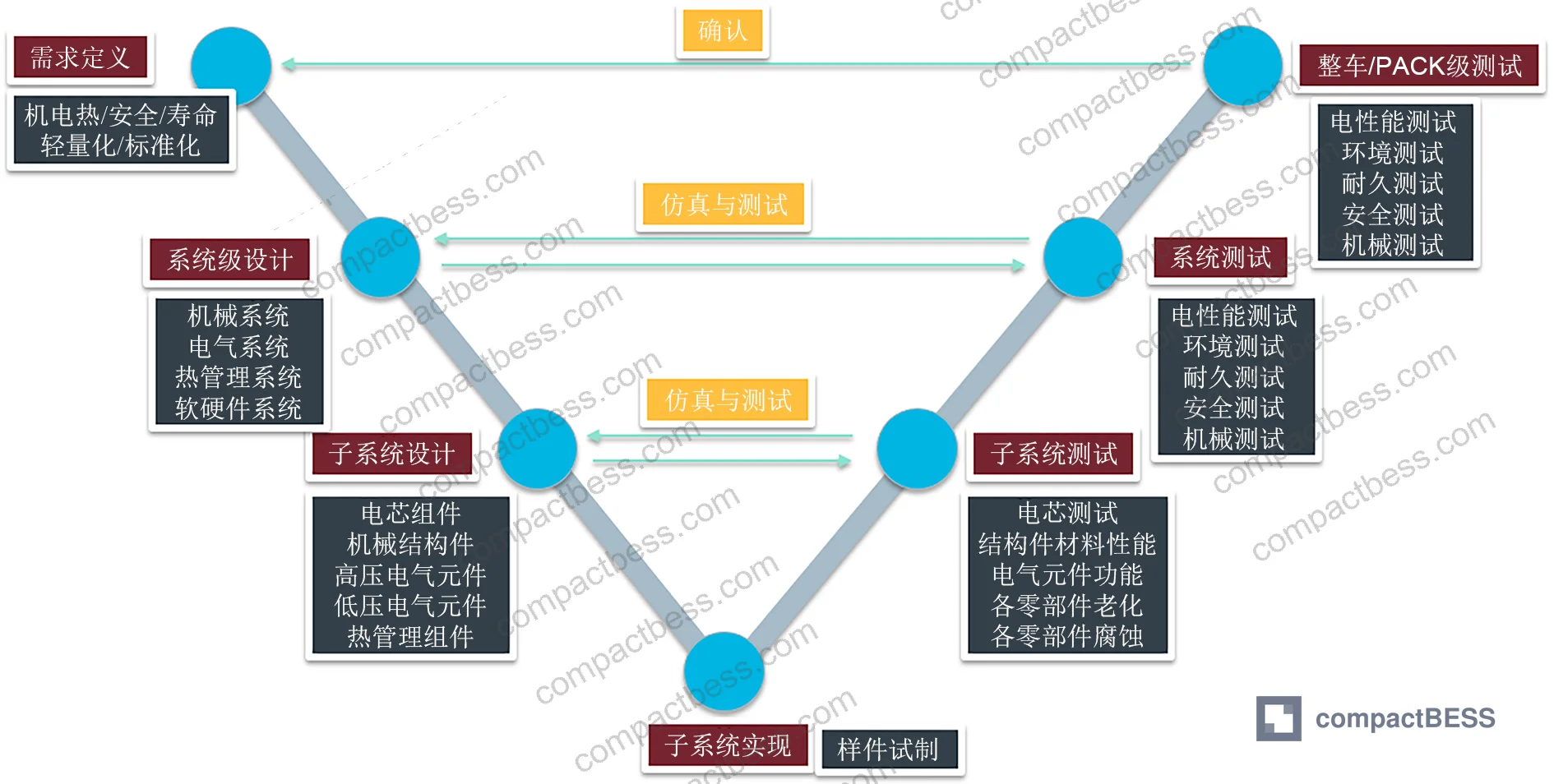
Procurement teams evaluating cell formats for the next generation of energy-dense pack designs need to pay close attention to what pouch-cell architecture actually demands from the module structure around it — and most don’t. The engineering data in this article draws on systematic development work conducted by an automotive OEM engineering team, covering simulation, prototype fabrication, and physical mechanical testing of a pouch lithium-sulfur module from first principles. The project followed an automotive V-model development process: requirements definition, simulation-based design, physical sample trials, and iterative test verification. Cell-level and module-level characterization included shock testing at up to 90 g, crush testing to 50 mm deformation, random vibration testing referenced to a power spectral density profile, and 10-item cell-level safety testing per GB/T 31485.
This body of work is directly relevant to buyers sourcing high-energy pouch modules for EV traction packs, portable energy storage, and high-density industrial applications. At compactbess.com, we work with procurement engineers and product development teams across North America, Europe, and the Middle East who are evaluating exactly these tradeoffs — and the structural data here changes how those conversations should be framed.
Lithium-Sulfur Pouch Cell Format: Dimensional Specifications and Energy Density Benchmarks #
The case for pouch format in lithium-sulfur chemistry is not primarily aesthetic — it’s mechanical. Lithium-sulfur cells undergo significant volumetric change during cycling: the metal lithium anode expands and contracts perpendicular to the electrode surface, and elemental sulfur transforms into solid lithium sulfide, producing additional volume shifts. A prismatic hard case simply cannot accommodate this. The rigid enclosure reaches stress limits before the cell can complete useful cycling. Pouch format, by contrast, allows the cell to expand and compress within controlled bounds while the surrounding module structure manages the resulting pressure.
The cell evaluated here uses a single-sided tab pouch format at 97 mm × 120 mm × 9 mm. Capacity is 20 Ah per cell, with a cell-level energy density of 350 W·h/kg. The sulfur-carbon composite cathode, combined with a solid-gel hybrid electrolyte, addresses the two classic failure modes of lithium-sulfur: lithium dendrite growth on the anode is partially suppressed by the solid electrolyte component, and polysulfide shuttle — which degrades capacity rapidly — is controlled by the gel phase’s interaction with the composite cathode interface. This hybrid electrolyte approach raises usable cycle count to above 90 cycles in validated testing.
For context on how this positions against current commercial formats, see our Cell Formats & Form Factors reference section, which covers cylindrical, prismatic, and pouch comparisons across multiple chemistries.
Chemistry Cost Reference #
Raw material cost context matters here. Current industry pricing for NMC cathode material runs approximately ¥150,000/tonne, while LFP runs around ¥60,000/tonne. Elemental sulfur — the lithium-sulfur cathode feedstock — prices at approximately ¥2,600–2,800/tonne. That cost differential is substantial, and it’s one reason lithium-sulfur continues to attract serious development resources despite the cycle life gap relative to intercalation chemistries.
Cell Format Comparison: Lithium-Sulfur Pouch vs. Conventional Module Formats #
| Parameter | Li-S Pouch Module (This Design) | NMC Module (Typical) | LFP Module (Typical) |
|---|---|---|---|
| Cell-level energy density | 350 W·h/kg | 230–270 W·h/kg | 160–190 W·h/kg |
| Module-level energy density | 250 W·h/kg | 180–220 W·h/kg | 130–160 W·h/kg |
| Cell format | Pouch (soft pack) | Prismatic or pouch | Prismatic or cylindrical |
| Cathode raw material cost | ~¥2,600–2,800/tonne (S) | ~¥150,000/tonne (NMC) | ~¥60,000/tonne (LFP) |
| Preload requirement | 600–800 N (critical) | Low to moderate | Low |
| Current cycle life | ~90+ cycles (validated) | 500–2,000+ cycles | 2,000–4,000+ cycles |
| Volume change during cycling | High (requires managed compression) | Low to moderate | Low |
Honestly, most buyers look at the 90-cycle figure and stop reading. That’s a costly mistake when the application is a weight-constrained platform — aerospace ground support, high-altitude UAV packs, or race-series EV applications — where the energy density premium over NMC justifies a different lifecycle economic model. The cycle life gap is real, but it’s a known development target, not a permanent ceiling.
Module Structure Design for High-Energy Pouch Cell Formats #
Getting the cell format right is only half the problem. The module structure around a high-expansion pouch cell is where most supplier qualification failures occur in practice — and where buyers without direct experience in pouch module procurement get caught.
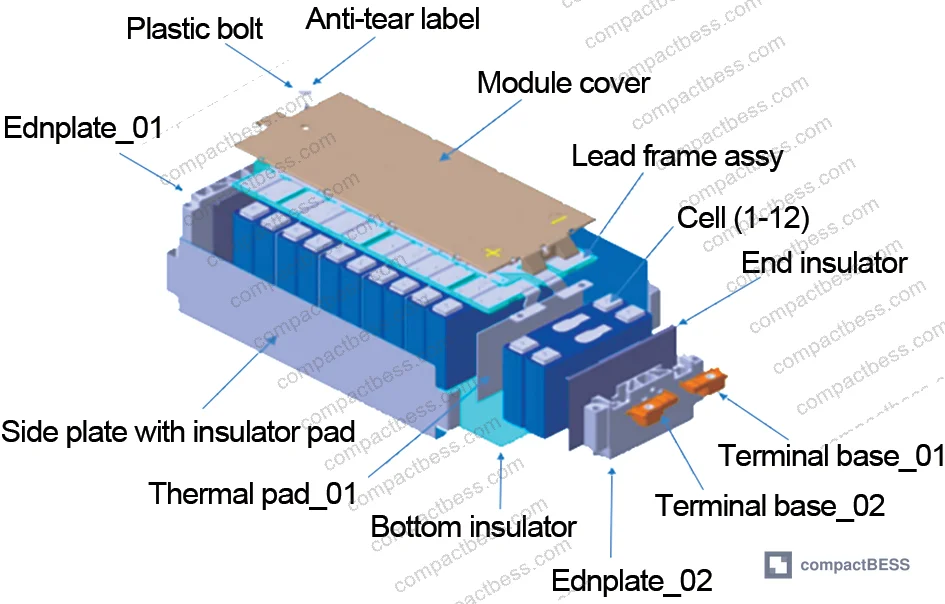
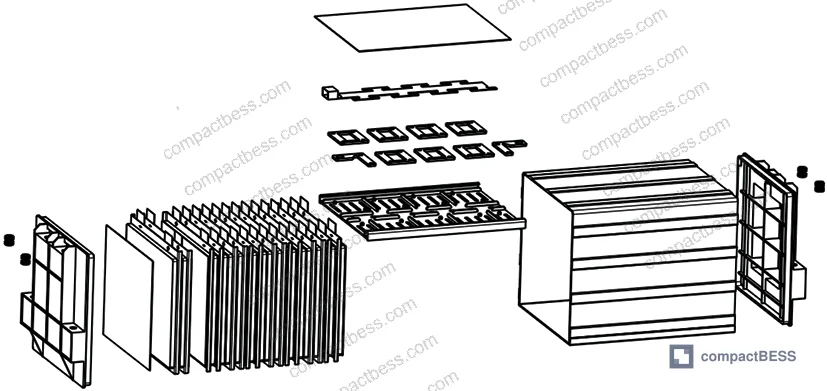
The module configuration places 16 cells in a 2-parallel, 8-series (2P8S) arrangement. Overall module dimensions are 198 mm × 138 mm × 134 mm, total weight 2.50 kg, rated output voltage 16.8 V, and total energy 571 W·h. Achieving 250 W·h/kg at the module level from 350 W·h/kg cells requires aggressive lightweight engineering: the primary structural frame is a magnesium alloy return-frame (回型框) with integrated reinforcement beams, with a density of 1.7 g/cm³ and elastic modulus of 44.8 GPa. End plates are fabricated from high-strength ABS+PC composite (density 1.4 g/cm³) — in prototype fabrication, 3D-printed; in production, injection-molded. PP material (density 0.9 g/cm³, elastic modulus 2.58 GPa) is used for insulation components.
This material selection is not arbitrary. Magnesium alloy at 1.7 g/cm³ is roughly 35% lighter than aluminum alloy at equivalent structural cross-section, and the integrated beam design distributes shock loads without the weight penalty of a conventional steel frame. The gap between cells and frame is filled with thermally conductive structural adhesive, which simultaneously fixes the cells against vibration-induced collision, improves overall thermal conductivity, and contributes to the module’s integral rigidity.
Preload Engineering: The Detail Most Suppliers Skip #
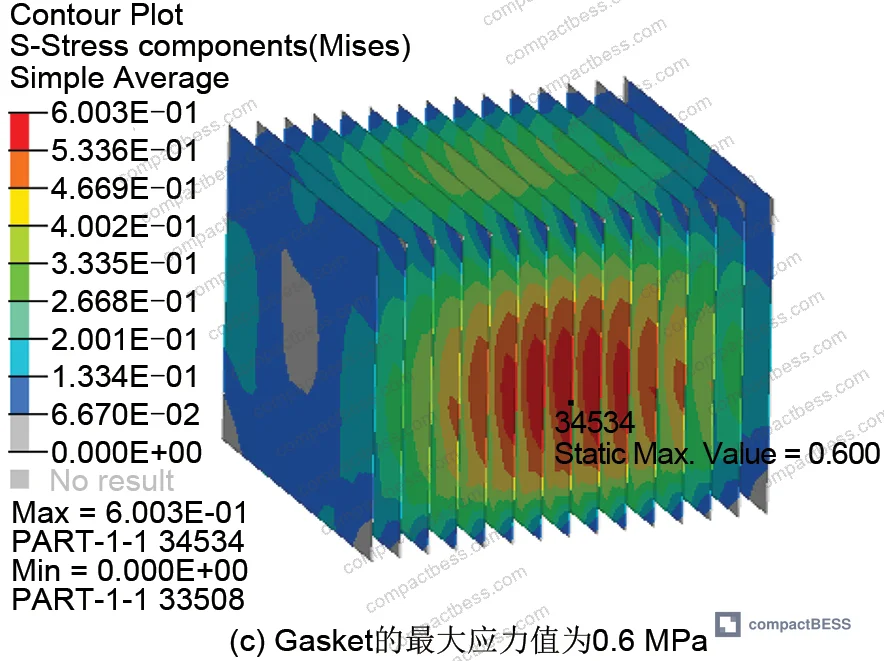
The module maintains 600–800 N of compressive preload between cells throughout the operating cycle. This is not a safety margin — it is a direct cycle life parameter. Lithium metal anodes degrade through surface pulverization when inadequate pressure fails to maintain electrode-electrolyte contact as the anode contracts on discharge. At 600–800 N, the study confirmed significant improvement in cycle stability versus unloaded cells. Preload is maintained by the end plate geometry and silicon rubber gaskets between cells, with the graphite thermal pad’s silicone border frame providing secondary compression control.
Between each pair of cells, a thermally conductive graphite sheet with silicone border frame manages heat distribution while contributing to preload maintenance. This dual function — thermal and mechanical — is a design efficiency that not all suppliers replicate. Most procurement teams don’t realize that in pouch module design, the thermal management layer and the mechanical preload system are typically the same component, and specifying them independently in an RFQ will get you confused responses from underprepared suppliers.
For deeper coverage of how module configuration affects electrical and thermal behavior, see our Series & Parallel Configuration technical guide.
Mechanical Simulation and Physical Test Results #
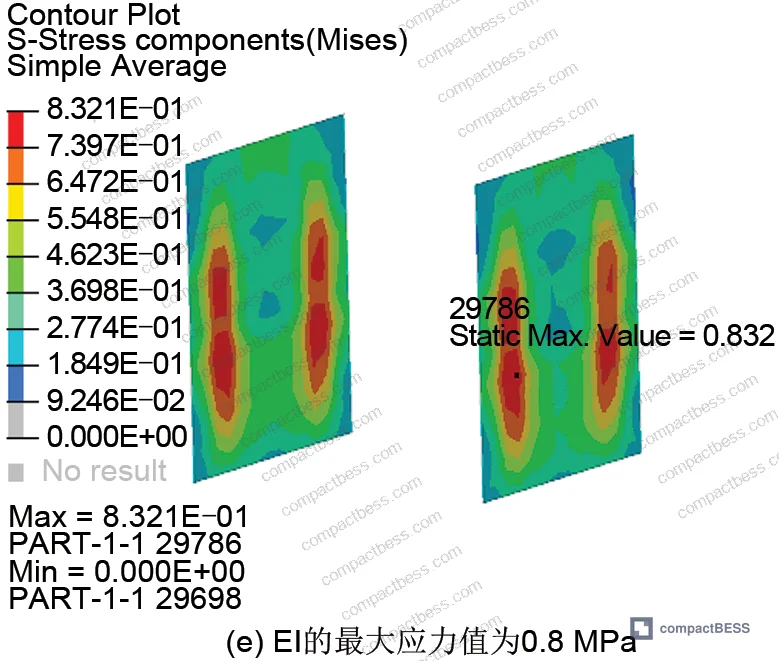
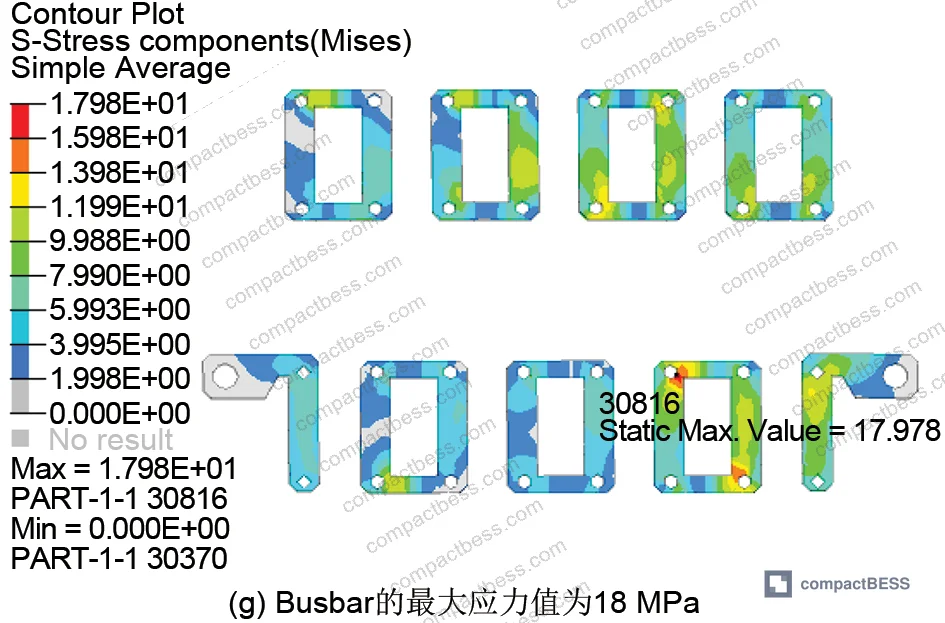
The engineering team ran CAE analysis using Hypermesh and ABAQUS across three test modes: shock, crush, and random vibration. Physical testing followed VW 80000 standard requirements and referenced GB/T 31485—2015 for cell-level safety evaluation.
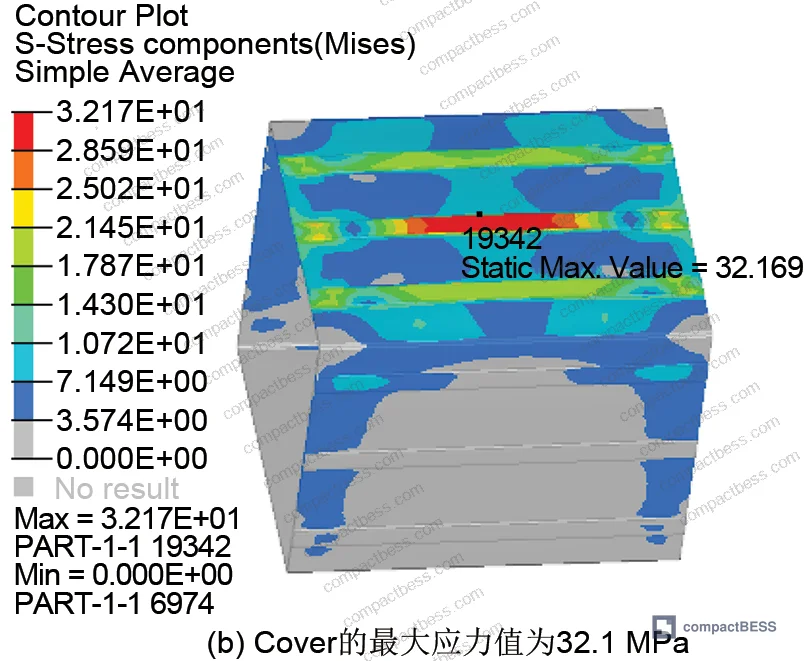
Shock simulation and test: Simulation showed stability under 30 g, 60 g, and 90 g loading in all three axes. Maximum stress in the module occurred at the reinforcement beam of the magnesium alloy frame: 32.1 MPa, below the material’s maximum allowable stress. Physical testing used 50 g and 60 g half-sine shock waveforms. Post-test inspection confirmed no cracking, no component separation, and intact electrical connections. All 50 g shock response curves across x, y, and z axes fell within acceptable bounds.
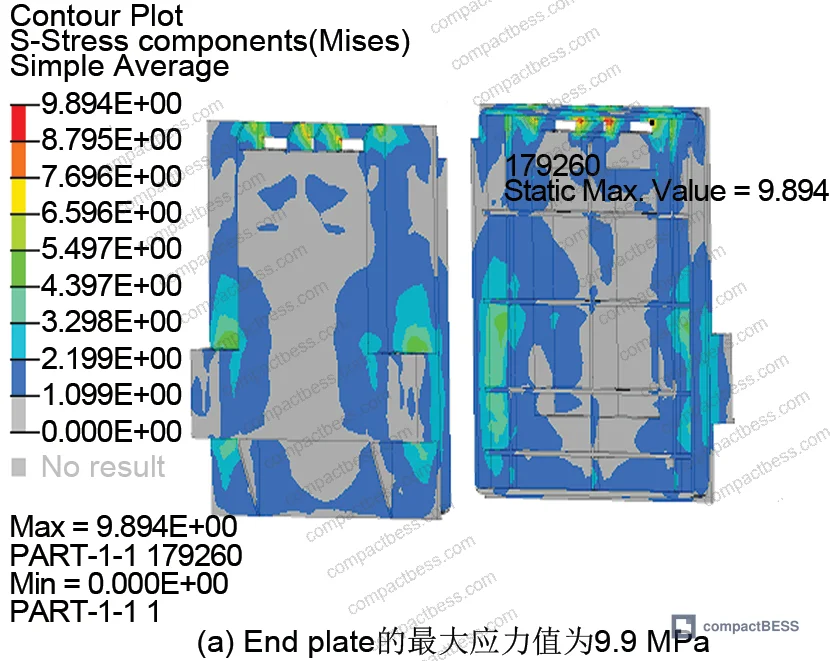
Crush simulation and test: Simulation predicted maximum crush force of 22.7 kN at 50 mm deformation (30% of module dimension). Physical testing revealed partial divergence from simulation: at 10 kN crush force, deformation had already reached 50% of module height, with the end plate fracturing and one plate separating from the return frame. The end plate-to-frame connection strength was identified as the primary structural weakness — the adhesive bond in that interface required redesign.
In supplier qualification, this is exactly the kind of failure mode that separates a supplier who has done real test-and-iterate development from one who has only run simulations. Three of the initial structural configurations failed the crush correlation test before the end plate bond area was increased sufficiently to bring simulation and test results into alignment.
Random vibration simulation: All structural components passed the allowable stress limit in random vibration simulation — except for one: the adhesive interface between the end plate and the magnesium frame showed a stress of -0.71 MPa, slightly below the simulation requirement. The response was to increase the bonded contact area between end plate and frame, which resolved the deficiency in subsequent simulation runs. Physical random vibration testing (using VW 80000 power spectral density profile) confirmed that the optimized design met requirements.
Cell-level safety testing: Ten safety tests per GB/T 31485—2015 were completed on the lithium-sulfur cell: overdischarge, overcharge, short circuit, drop, heating, crush, nail penetration, seawater immersion, thermal cycling, and low pressure. All 10 tests returned pass results.
The compliance baseline for industrial module safety is IEC 62619:2022 Safety requirements for secondary lithium cells and batteries. For transport certification relevant to cross-border shipment of lithium-sulfur modules, UN 38.3 Recommendations on the Transport of Dangerous Goods — Lithium Battery Testing applies regardless of chemistry. Buyers targeting the European market also need to understand the obligations under EU Battery Regulation 2023/1542 — Requirements for batteries placed on the EU market, which introduces traceability and due diligence requirements that will affect novel chemistry supply chains specifically.
Practical Guidance for Buyers #
If you’re evaluating high-energy pouch modules — whether lithium-sulfur or advanced NMC pouch — the structural engineering requirements are fundamentally different from what prismatic or cylindrical pack buyers are used to. The preload specification (600–800 N) is not optional, and it needs to be verifiable. Ask suppliers for documentation showing how preload is set at assembly and how it is maintained across the rated temperature range.
The magnesium alloy frame approach used here is an effective weight reduction strategy, but it introduces manufacturing complexity that not all Tier 2 and Tier 3 suppliers handle well. When auditing a supplier, ask to see their CAE simulation results alongside physical test correlation data. If a supplier can only provide simulation outputs without physical test correlation, that’s a qualification flag.
For buyers sourcing 250 W·h/kg-class modules for integration into EV packs or high-energy portable systems, the 2P8S cell arrangement (16 cells per module, 571 W·h total, 16.8 V nominal) represents a validated architecture worth using as a baseline specification. Adjust string configuration based on your system voltage requirements, but treat the cell-level preload and thermal graphite pad design as non-negotiable structural elements.
Our sourcing team at compactbess.com connects global OEM buyers and energy storage integrators with verified Chinese manufacturers of advanced cell modules — including pouch format designs for high-energy applications. If you’re at the RFQ stage, we can help you identify suppliers with documented mechanical simulation and test correlation data rather than paper specifications alone.
Need help identifying qualified suppliers for high-energy pouch cell modules? Talk to our sourcing team →
Supplier Qualification Questions #
- What is the measured cell-level energy density of your pouch lithium-sulfur or high-energy pouch cells, and can you provide test data showing the cell achieves ≥300 W·h/kg under standard discharge conditions?
- What preload force (in Newtons) does your module structure apply between cells at assembly, and how do you verify that the 600–800 N range is maintained after thermal cycling and after a specified number of charge-discharge cycles?
- Can you provide CAE simulation results (shock, crush, and random vibration) alongside physical test correlation data — specifically showing that maximum component stress in shock testing remains below the material’s allowable stress at 30 g, 60 g, and 90 g loading?
- In crush testing, at what force level (kN) and deformation percentage does your module design meet the no-HL4-event requirement, and how does this correlate with your simulation prediction for crush force at 30% module deformation?
- What is the adhesive bond strength specification (in MPa) for your end plate-to-frame interface, and how was this determined — specifically, do you have random vibration test data showing the bond performs at or above -0.71 MPa under the applied power spectral density profile?
Sourcing Checklist #
- ☐ Cell format confirmed as pouch (soft pack) with documented dimensional tolerance for the stated nominal size (e.g., 97 mm × 120 mm × 9 mm or equivalent)
- ☐ Cell-level energy density verified at ≥300 W·h/kg via third-party or in-house test report under standard discharge conditions
- ☐ Module-level energy density verified at ≥220 W·h/kg with module weight and energy capacity measurement traceable to a calibrated test record
- ☐ Preload design documented and confirmed in the range of 600–800 N with a specified maintenance mechanism (e.g., silicone gasket, frame geometry) across operating temperature range
- ☐ CAE simulation outputs (Hypermesh/ABAQUS or equivalent) provided for shock, crush, and random vibration, with physical test correlation confirming maximum stress below material allowable values
- ☐ Cell-level safety test report covering all 10 items per GB/T 31485 (or IEC 62619:2022 equivalent): overdischarge, overcharge, short circuit, drop, heating, crush, nail penetration, seawater immersion, thermal cycling, low pressure
- ☐ Module structural frame material specified with density and elastic modulus (e.g., magnesium alloy: 1.7 g/cm³, 44.8 GPa) and verified against design stress calculations
- ☐ UN 38.3 transport certification current and applicable to the shipped cell chemistry and configuration
Key Specifications Table #
| Parameter | Recommended Value | Verification Method |
|---|---|---|
| Cell energy density (pouch Li-S) | ≥350 W·h/kg | Gravimetric capacity test at C/5 discharge; verified per GB/T 31485 or IEC 62619 |
| Module energy density | ≥250 W·h/kg | Weigh completed module; measure total Wh at rated discharge; calculate ratio |
| Cell preload force | 600–800 N | Inline load cell measurement at assembly; re-measurement after 10 thermal cycles |
| Cell dimensions (pouch) | 97 mm × 120 mm × 9 mm ±0.3 mm | Caliper measurement of 5 cells per lot; CMM for production batches |
| Module shock resistance | Pass at 50 g and 60 g half-sine; no HL4 event | Physical shock test per VW 80000 or equivalent automotive module standard |
| Maximum structural stress (shock) | ≤32.1 MPa at frame reinforcement beam | CAE simulation with Hypermesh/ABAQUS; correlation to physical test result |
| Crush resistance | No HL4 event; deformation ≤50% at ≥10 kN | Physical crush test per applicable standard; force-displacement curve provided |
| Cycle life (hybrid electrolyte) | ≥90 cycles at stated capacity retention | Cycle test at 25°C, C/2 charge/discharge, capacity measured every 10 cycles |
Can’t find a supplier meeting these specs? Submit your requirements and we’ll match you within 48 hours.
References #
Data source: Structural Design and Mechanical Validation of a High-Specific-Energy Lithium-Sulfur Battery Module for Automotive Applications, R. Yuan et al., Journal of the Electrochemical Society, 2025
Frequently Asked Questions #
Why is pouch format preferred over prismatic hard case for lithium-sulfur cells?
Lithium-sulfur cells undergo large volumetric change during cycling — the lithium metal anode expands and contracts perpendicular to its surface, and elemental sulfur converting to lithium sulfide adds further dimensional variation. A prismatic hard case has fixed geometry and cannot accommodate these changes without exceeding material stress limits. Pouch format allows the cell to swell and compress within bounds managed by the module frame, while the module’s preload system actively maintains electrode contact pressure throughout cycling.
What cycle life can buyers expect from a validated lithium-sulfur pouch module today?
The validated prototype described here achieved over 90 cycles using a solid-gel hybrid electrolyte that suppresses polysulfide shuttle and reduces lithium dendrite growth. This is well below commercial NMC or LFP cycle life, and buyers should plan accordingly. Lithium-sulfur is currently a fit for applications where gravimetric energy density is the dominant selection criterion and cycle life economics are acceptable — not a replacement for LFP in high-cycle-count stationary or fleet applications.
What does the 600–800 N preload requirement mean for module assembly?
It means the module must apply controlled compressive force between cells at the point of assembly, and that force must be maintained mechanically — not just set once and forgotten. In the validated design, this is achieved by the end plate geometry combined with silicone rubber gaskets and the graphite thermal pad’s silicone border frame. Any supplier claiming to build a lithium-sulfur module without a defined, measurable preload specification is either using a different architecture or skipping a critical design element.
How does module energy density of 250 W·h/kg compare to today’s best commercial EV modules?
Current commercial NMC modules for passenger EVs typically reach 180–220 W·h/kg at the module level. LFP modules are generally in the 130–160 W·h/kg range. The 250 W·h/kg demonstrated here represents a meaningful step above commercial NMC — roughly 15–40% improvement. The gap is achieved through a combination of higher cell energy density (350 W·h/kg) and aggressive lightweight structural design using magnesium alloy framing and ABS+PC composite end plates.
Does EU Battery Regulation 2023/1542 affect procurement of lithium-sulfur modules?
Yes, and the implications are broader than most procurement teams currently account for. The regulation introduces due diligence, traceability, and battery passport requirements that apply to all battery chemistries placed on the EU market above certain thresholds. For a novel chemistry like lithium-sulfur — where supply chains are less mature than for NMC or LFP — documenting material provenance and establishing battery passport compliance will require earlier supplier engagement than standard procurement timelines typically allow. Buyers targeting EU markets should factor this into their qualification schedule from the outset.
Published by compactbess.com Technical Team | Request a sourcing quote


