

TL;DR #
Retired EV power battery packs reaching second-life application carry internal degradation patterns — lithium dendrite formation, electrolyte decomposition, and increased thermal runaway risk — that make direct application of new-battery standards both technically inappropriate and economically wasteful. Buyers sourcing second-life battery cells or modules for energy storage integration must understand that existing GB/T national standards cover only the early disassembly and residual capacity detection phases, leaving electrical performance thresholds, sorting criteria, and re-retirement triggers entirely unregulated at the national level. Before issuing any RFQ for second-life battery cells or reconfigured modules, require suppliers to demonstrate a documented state-of-health grading protocol and a traceable battery coding system aligned with GB/T 34014.
Overview #
Sourcing second-life power battery cells is not a niche procurement edge case — it is becoming a mainstream option for stationary energy storage integrators who need lower-cost chemistry at the cost of accepting more screening complexity. The engineering challenge is that the standard framework hasn’t kept pace with the supply wave. Cumulative EV battery retirement volumes in China are projected to exceed 90 GWh by 2025, and a substantial fraction of that volume is serviceable in lower-stress applications such as grid buffer storage and residential backup systems. The problem for buyers is qualifying what “serviceable” actually means when no unified national threshold exists.
Research conducted by a state-level grid power research institution — examining the complete regulatory framework across disassembly, residual capacity testing, electrical performance, and safety qualification — reveals a structural gap: only four national standards currently address second-life battery utilization (GB/T 33598, GB/T 34015, GB/T 34015.2, and GB/T 8698.1), and all four cover only the upstream pre-processing stage. None address what happens after the battery is disassembled, sorted, and ready for redeployment. That gap is where procurement risk concentrates.
For cell format and form factor decisions, the dimensional standardization standard GB/T 34013 exists specifically to resolve the mismatch between retired EV cell geometries and stationary storage enclosure designs — but it is rarely referenced in supplier qualification conversations, which is a missed opportunity.

Cell Format Standardization and Dimensional Specifications for Second-Life Battery Procurement #
The single most concrete tool available to buyers navigating second-life cell sourcing is GB/T 34013, which specifies dimensional requirements for EV power battery cells, modules, and standard enclosure boxes. This standard was developed precisely because dimensional non-uniformity was identified as a primary barrier to efficient retirement and reuse — batteries from different OEMs arriving in different geometries cannot be rack-mounted or module-integrated without custom mechanical work that destroys unit economics.
The current national standard coverage for second-life processing breaks down as follows:
| Processing Stage | Applicable Standard | Key Limitation |
|---|---|---|
| Pack disassembly to cell level | GB/T 33598-2017 | Covers procedure only; no performance threshold |
| Residual capacity detection | GB/T 34015-2017 | Test at ≤0.2C (I5); no pass/fail value defined; ~10 h per test |
| Pack removal from vehicle | GB/T 34015.2-2020 | Disassembly procedure only |
| Packaging and transport | GB/T 8698.1-2020 | Classifies into 3 hazard levels; transport rules only |
The residual capacity test in GB/T 34015-2017 requires charging and discharging at a current no higher than 0.2C (I5). The test duration is approximately 10 hours per cell or module. There is no defined threshold for what constitutes an acceptable residual capacity — the standard provides a method without a pass/fail criterion. For a buyer receiving a batch of 500 modules, this means roughly 5,000 person-hours of test time with no standardized acceptance gate at the end. That is not a viable industrial workflow.
Honestly, most procurement teams treat the existence of a GB/T test procedure as equivalent to having a qualification standard. It isn’t. A method without a threshold is a measurement protocol, not a quality gate.
For buyers also evaluating cycle life and degradation characteristics of second-life cells, the absence of a re-retirement threshold standard compounds the risk — there is currently no national benchmark defining when a second-life battery has degraded to the point of mandatory withdrawal from service.
The battery traceability coding standard GB/T 34014 provides the identification backbone: unique coding per cell covering production management, maintenance history, and recycling chain responsibility. Suppliers who cannot provide GB/T 34014-compliant battery ID data on incoming second-life stock are operating without chain-of-custody visibility, which should be an automatic disqualification in any serious supplier audit.
Safety Performance Testing Gaps in Second-Life Cell Qualification #
Safety testing is where the standard gap becomes genuinely hazardous rather than merely procedurally inconvenient. The mandatory safety standard GB 38031-2020 — which replaced GB/T 31485-2015 and GB/T 31467.3-2015 and became China’s first mandatory national standard for EV battery safety — covers thermal, mechanical, electrical, and functional safety requirements from cell to system level. It applies to new batteries. Applying it directly to second-life cells introduces two categories of error.
First, many abuse tests in GB 38031-2020 simulate failure modes specific to new batteries in high-stress EV applications: nail penetration, crush, high-altitude simulation, seawater immersion, temperature cycling. For second-life batteries deployed in stationary storage with controlled indoor environments and single-direction load profiles, several of these tests are either unnecessary or insufficiently representative. Eliminating them from the protocol reduces cost; retaining them without adjustment wastes resources without improving safety assurance.
Second, and more critically, second-life cells have fundamentally different internal states than new cells. Long-term cycling degrades positive and negative electrode materials, consumes electrolyte, and degrades separator integrity. Lithium dendrite formation is a documented outcome of extended cycling. The practical consequence: thermal runaway onset temperature is lower than in new cells, heat generation rate is faster, and cell-to-cell consistency within a batch is significantly worse.
In supplier qualification reviews, testing against the new-battery standard framework without adjustment for these characteristics produces false confidence. We’ve seen batches of second-life cells pass visual inspection and initial voltage screening, then fail thermal event propagation testing because individual cells within the batch had reached internal states that simple external parameter checks cannot detect.
The recommended approach — supported by the research framework — combines two test tiers: fast external-parameter screening (appearance, capacity, internal resistance, temperature rise) to eliminate obviously high-risk cells, followed by selective destructive abuse testing on a statistically sampled subset. For stationary storage second-life applications, overcharge and over-discharge tests should be retained; nail penetration and crush tests may be reduced or eliminated. This two-tier structure reduces cost while maintaining meaningful safety assurance.
IEC 62619:2022 Safety requirements for secondary lithium cells and batteries provides the international benchmark for secondary lithium battery safety that second-life qualification protocols should cross-reference, particularly for thermal propagation and abuse tolerance requirements.
For buyers integrating second-life packs into stationary applications, NFPA 855 Standard for the Installation of Stationary Energy Storage Systems is a mandatory reference for any North American project — and its fire suppression requirements specifically account for the different combustion characteristics and re-ignition behavior of aged lithium cells, which differ meaningfully from new-cell assumptions in terms of extinguishant volume and suppression duration.
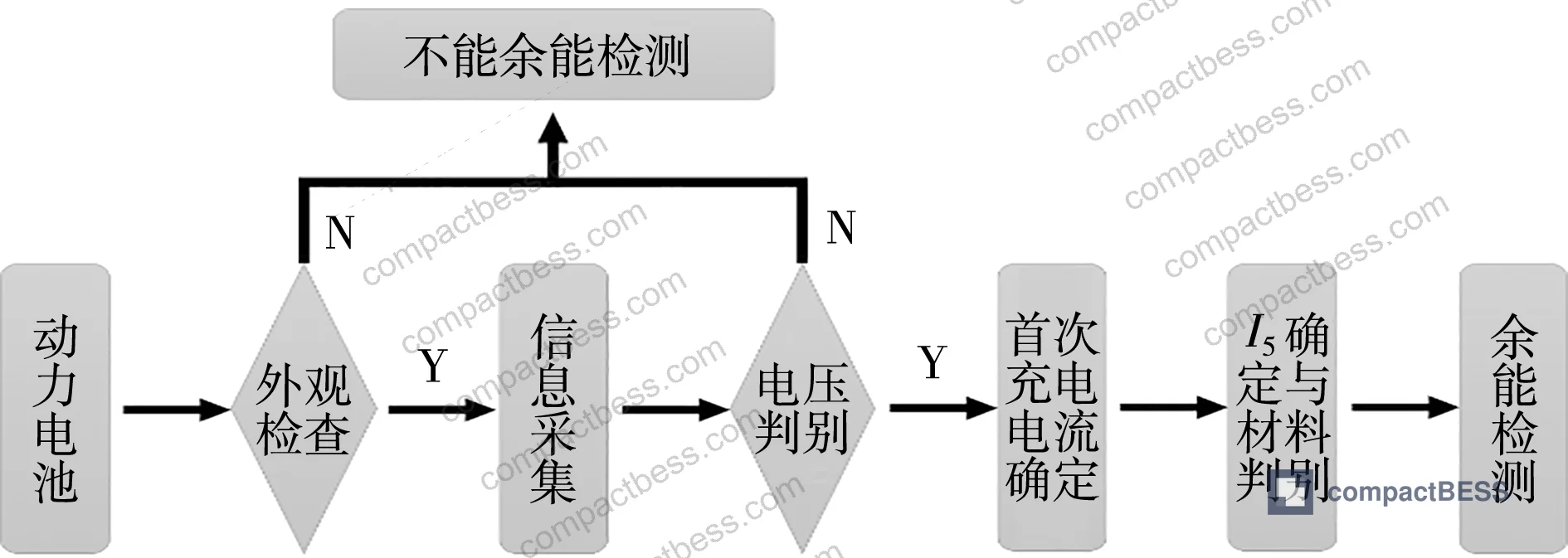
The internal resistance increase rate and capacity retention rate are the two fastest proxies for second-life cell state. A cell showing internal resistance growth exceeding the threshold for its chemistry, or capacity retention below the application-specific floor, should be rejected before any destructive testing is even considered. The research framework explicitly identifies internal resistance growth rate and heat generation during charge/discharge as early-stage rejection criteria that minimize downstream test cost.
Most procurement teams don’t realize that the fire behavior of aged lithium cells — both the combustion products and the re-ignition tendency — differs substantially from what new-battery fire suppression standards assume. Extinguishant quantities calibrated for new batteries may be insufficient for a second-life storage installation, which has direct implications for facility permitting and insurance.
Practical Guidance for Buyers #
If you’re sourcing cells or modules for a second-life energy storage application, the standard framework is not going to protect you the way it would in a new-battery procurement. You need to build the qualification layer yourself — or work with sourcing partners who have already built it.
Start with traceability. Any supplier who cannot provide GB/T 34014-compliant cell-level coding data on their incoming stock is sourcing blind. Provenance determines degradation history, and degradation history determines whether a given cell is appropriate for your application voltage range and thermal envelope. Reject suppliers who cannot produce this data.
For electrical performance, require fast screening data: capacity retention percentage, internal resistance absolute value and growth rate, and charge/discharge heat generation profile. A 10-hour full C/5 cycle is appropriate for final qualification of selected samples — it is not a triage tool for incoming lots.
For safety qualification, require documentation of the specific abuse tests performed and the sampling ratio used. A supplier claiming full GB 38031-2020 compliance on a second-life lot without specifying which test items were adjusted for the application environment is either unqualified or not being transparent. Both are problems.
Buyers targeting EU markets should also cross-reference EU Battery Regulation 2023/1542 requirements, which impose due diligence and traceability obligations on batteries placed in the European market — requirements that second-life battery supply chains are particularly exposed to.
At compactbess.com, we work directly with verified Chinese manufacturers who supply second-life battery cells, reconfigured modules, and complete stationary storage assemblies to OEM buyers and energy storage integrators across North America, Europe, and Southeast Asia. Our qualification process includes supplier audit against the specific screening criteria described here — not just certificate collection.
Need help identifying qualified suppliers for second-life battery cells or reconfigured storage modules? Talk to our sourcing team →
Supplier Qualification Questions #
- What is your residual capacity detection method for incoming second-life cells — specifically, what test current (C-rate) do you use, and what is your defined acceptance threshold for capacity retention percentage?
- Can you provide GB/T 34014-compliant battery coding records for each cell or module lot, demonstrating full chain-of-custody traceability from original EV manufacturer through retirement?
- For safety qualification of second-life lots, which specific test items from GB 38031-2020 do you apply, which do you modify for stationary storage application conditions, and what sampling ratio do you use for destructive abuse testing?
- What are your defined rejection thresholds for internal resistance absolute value and internal resistance growth rate, and what measurement method and conditions do you use to determine these values?
- How do you classify incoming second-life battery stock into the three hazard levels specified under GB/T 8698.1-2020, and what are the specific insulation and appearance criteria that determine each grade assignment?
Sourcing Checklist #
- ☐ Supplier provides GB/T 34014-compliant cell-level coding data with unique identifiers for 100% of incoming second-life stock
- ☐ Residual capacity screening is conducted at ≤0.2C (I5) with a documented pass/fail capacity retention threshold specific to the target application
- ☐ Internal resistance measurement data is available per cell/module, with defined rejection threshold for both absolute value and growth rate
- ☐ Safety qualification documentation specifies which GB 38031-2020 test items are applied, which are modified for stationary storage conditions, and the destructive test sampling ratio used
- ☐ Incoming stock is classified into hazard grades per GB/T 8698.1-2020 (3-level classification) prior to shipment preparation
- ☐ Cell dimensional specifications are confirmed against GB/T 34013 standard enclosure size requirements for the target integration format
- ☐ Fire suppression protocol for the supplied battery lot is documented separately from new-battery assumptions, with re-ignition suppression agent quantities specified
Key Specifications Table #
| Parameter | Recommended Value | Verification Method |
|---|---|---|
| Residual capacity detection current | ≤0.2C (I5 rate) | GB/T 34015-2017 charge/discharge protocol; ~10 h full cycle |
| Hazard classification grades for second-life stock | 3 levels based on insulation and appearance criteria | GB/T 8698.1-2020 pre-processing inspection checklist |
| Battery coding traceability | 100% unique cell-level ID per GB/T 34014 | Code scan cross-referenced against production and service history records |
| Thermal runaway onset temperature | Must be characterized and documented; expected lower than new-cell baseline | Charge/discharge heat generation profiling; calorimetric test under controlled conditions |
| Internal resistance growth rate | Defined rejection threshold per chemistry type | AC impedance or DC pulse measurement; compare against new-cell baseline for same format |
| Capacity retention floor for second-life deployment | Application-specific; stationary storage typically ≥70–80% of rated capacity | C/5 full charge-discharge cycle per GB/T 34015-2017 protocol |
Can’t find a supplier meeting these specs? Submit your requirements and we’ll match you within 48 hours.
References #
Data source: Standards Framework Analysis for Echelon Utilization of Retired Electric Vehicle Power Batteries: Gaps, Limitations, and Development Priorities, X.-T. Li et al., Journal of the Electrochemical Society, 2023
Frequently Asked Questions #
Can second-life EV battery cells be used directly in stationary energy storage systems without additional testing?
No. Second-life cells have degraded electrode materials, electrolyte consumption, and reduced thermal runaway onset temperatures relative to new cells. They require a documented state-of-health screening protocol covering capacity retention, internal resistance, and heat generation profiling before any deployment. Applying new-battery standards without adjustment is both technically inappropriate and a safety risk.
What is the GB/T 34015-2017 residual capacity test, and why isn’t it sufficient as a standalone qualification?
GB/T 34015-2017 specifies residual capacity detection using charge/discharge cycling at ≤0.2C (I5). The test takes approximately 10 hours per cell or module. Critically, the standard defines the test method but sets no pass/fail threshold — there is no defined minimum acceptable capacity retention value. For industrial-scale incoming inspection, this means the test produces data without a built-in acceptance gate, which buyers must define themselves based on their specific application requirements.
What does GB/T 34013 cover, and why does it matter for second-life procurement?
GB/T 34013 specifies dimensional requirements for EV power battery cells, modules, and standard enclosure boxes. It exists because dimensional non-uniformity between different OEM battery designs is a primary barrier to second-life reuse — cells that don’t match the enclosure format of a stationary storage rack require custom mechanical work that drives up integration cost. Confirming that incoming second-life stock meets GB/T 34013 dimensional specs before committing to a format is a basic due diligence step that many buyers skip.
How should buyers approach safety testing for second-life batteries differently from new batteries?
The recommended approach uses two tiers: fast external-parameter screening (appearance, capacity, internal resistance, temperature rise under charge/discharge) to eliminate high-risk cells early, then selective destructive abuse testing on a sampled subset. For stationary storage applications, overcharge and over-discharge tests should be retained; tests simulating EV-specific abuse scenarios such as nail penetration, crush, and high-altitude simulation may be reduced or eliminated. This structure maintains meaningful safety assurance while controlling test cost.
What traceability documentation should buyers require from second-life battery suppliers?
Require GB/T 34014-compliant battery coding records providing unique cell-level identification traceable to original EV manufacturer, production batch, and service history. This is non-negotiable — without this data, the buyer has no way to assess the degradation history of incoming stock or assign recall or liability responsibility if a safety event occurs post-deployment.
Published by compactbess.com Technical Team | Request a sourcing quote


