

TL;DR #
Retired EV power batteries entering second-life applications retain 70–80% of initial capacity, and when properly screened and reconfigured, they can reduce initial storage system investment costs by 20–30% compared to new-cell systems. For buyers procuring battery packs or modules for stationary storage, backup power, or low-speed EV applications, this creates a credible cost reduction pathway — but only if the supplier has rigorous consistency screening capability. Before engaging any second-life battery supplier, demand documented SOC/OCV/temperature consistency data with relative deviation ≤3% across the reconfigured pack.
Overview #
The economics of second-life battery procurement are shifting faster than most sourcing teams realize. Research conducted at a state-level electric power research institute — covering multi-scenario evaluation of retired EV battery modules, including capacity grading, appearance inspection, electrochemical characterization, and pack reconfiguration trials — makes a compelling quantitative case that echelon utilization is no longer a pilot-stage novelty. The scale is real: projected retired battery volumes in China alone are expected to grow from approximately 33.95 GWh to 380.3 GWh between 2023 and 2030, an increase exceeding 10×. That is not a background statistic — it is a direct signal about future supply availability and, critically, about the quality distribution challenges buyers will face as that wave hits.
The standard retirement trigger for EV batteries is when state of health (SOH) drops below 80% of original rated capacity. At that threshold, a cell or module is no longer fit for traction use, but it retains substantial usable energy. For buyers in cell formats and form factors decision-making, understanding where a retired cell sits dimensionally and electrochemically — before it enters a reconfigured pack — is the difference between a reliable energy storage asset and a maintenance liability.
EV battery service life is typically 5–8 years for passenger vehicles, or approximately 200,000 km of travel. Commercial EVs retire faster due to higher daily mileage and charge cycle frequency. Once retired, batteries are graded for second-life applications depending on their residual capacity: 30–80% SOH range covers power storage, low-speed EVs, and telecom backup. Below 30%, direct recycling is the only responsible path.
Retired Battery Cell Format Selection and Grading for Second-Life Applications #
Matching retired battery format to the target application is the first and most consequential decision in any second-life procurement. Not all retired battery formats behave the same way when reconfigured, and this is where many buyers stumble.
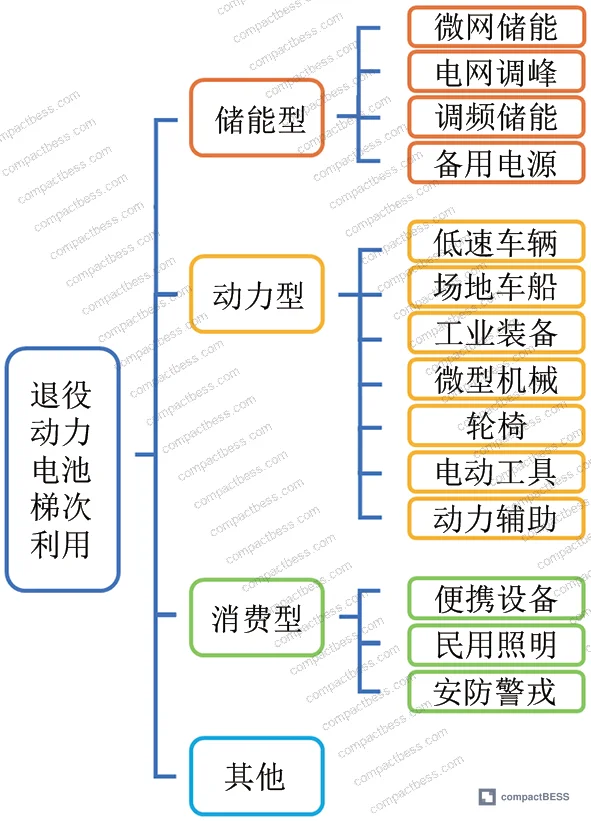
The full lifecycle application framework for power batteries breaks down as follows:
| SOH Range | Battery State | Suitable Application |
|---|---|---|
| ≥80% | Active traction use | EV propulsion, full dynamic load |
| 30–80% | Second-life echelon tier | Grid storage, low-speed EV, telecom UPS backup |
| <30% | End-of-life | Material recycling only |
For grid-side energy storage applications — including renewable energy buffering, peak shaving, frequency regulation, and distributed microgrid storage — any retired battery with SOH in the 30–80% window is a candidate, provided consistency screening has been completed. For dynamic power applications such as low-speed EVs and forklifts, the requirements are tighter: shorter route distances, easy charging access, and lower peak power demand mean that second-life cells can perform acceptably, but they must be matched more carefully for internal resistance uniformity.
Practically, cells are graded through a multi-stage screening process: visual inspection first (checking for swelling, electrolyte leakage, case deformation), followed by electrochemical characterization. Sorting targets in a mature operation should exceed 95% screening accuracy, with throughput rates above 5 individual cells per minute or 3 modules per minute. Most suppliers cannot meet both simultaneously — this is a real bottleneck you will encounter in RFQ evaluation.
Honestly, most buyers over-specify consistency requirements at the front end and then accept weak documentation at the back end. The right approach is the reverse: set a firm consistency threshold (SOC, OCV, temperature deviation ≤3% across the pack) and require documented batch test data before accepting any shipment.
For buyers working with cell consistency and matching requirements, the grading methodology the supplier uses — whether capacity-based, impedance-based, or multi-parameter combined — will directly determine how the assembled pack degrades over time.
Screening, Reconfiguration, and Safety: Where Second-Life Battery Projects Actually Fail #
This is the section most procurement guides skip. The technical challenge in second-life battery systems is not identifying usable cells — it is managing the consistency degradation that emerges after reconfiguration and during ongoing operation.
In supplier qualification evaluations of second-life battery systems, three of the most common failure patterns are: (1) packs assembled with cells that passed initial capacity screening but had mismatched internal resistance, leading to accelerated degradation of weaker cells; (2) SOH estimation errors that caused the BMS to apply incorrect charge/discharge limits, shortening useful life further; and (3) safety events during extended cycling due to aging patterns that were not detectable at commissioning. These are not theoretical risks — they are documented failure modes in large-scale demonstration projects.
The safety assessment framework for second-life batteries requires evaluating cells and modules at multiple levels. Individual cells that show swelling or electrolyte leakage during visual inspection must be removed before any further testing. Those passing visual checks proceed to electrochemical evaluation: capacity verification, internal resistance measurement, and OCV stability testing. Reconfigured packs must then pass system-level safety validation — thermal behavior under load, fault response from the BMS, and cycling stability.
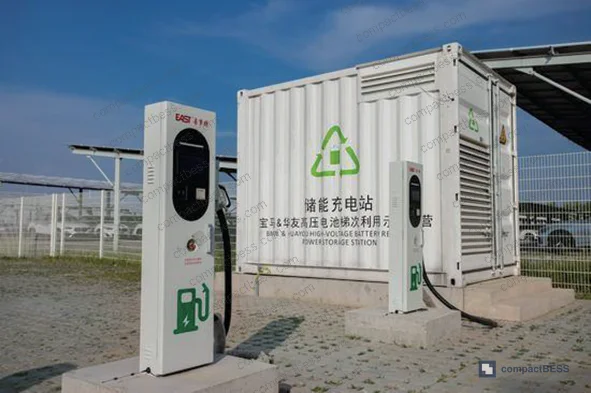
The global deployment record demonstrates that this is achievable at scale. A 570 kWh storage station assembled from 96 MEB module units, a 485 kW/1260 kWh grid-connected system built from retired EV battery cells, and a 2 MW/2 MWh large-scale photovoltaic storage facility using batteries from retired passenger EVs are all operational. A 2 MWh second-life storage station for grid-side applications was built and commissioned for grid testing purposes. A 25 MW battery storage system incorporated 10,000 battery modules primarily sourced from retired electric forklifts and buses. A 100 kW system was developed specifically to validate control systems and hardware solutions for second-life applications.
Most procurement teams don’t realize that the BMS requirements for second-life battery packs are fundamentally more demanding than for new-cell packs — because the aging state of each cell in the pack is non-uniform from day one. Standard BMS designs optimized for new cells are frequently inadequate. This matters for buyers evaluating SOH and RUL prediction capability in their suppliers’ systems — it is not a nice-to-have feature, it is a core safety requirement.
The reconfiguration cost advantage is real but conditional. When second-life battery safety issues are properly addressed, initial investment cost is 20–30% lower than equivalent new-cell storage systems. The new cell price is approximately 2× the recovery price of retired batteries. That spread funds the screening, grading, and BMS engineering required to make the system safe. Suppliers who quote second-life systems at aggressive prices without documenting safety validation are cutting corners on exactly the processes that protect you.
Safety and compliance frameworks for second-life battery systems should reference IEC 62619:2022 Safety requirements for secondary lithium cells and batteries, which establishes the baseline safety requirements applicable to second-life battery assemblies used in stationary storage applications. For buyers specifying transport certification for retired battery shipments, UN 38.3 Recommendations on the Transport of Dangerous Goods — Lithium Battery Testing applies to the movement of lithium cells regardless of first-life or second-life status. System-level installation requirements for stationary systems in North American markets are addressed under NFPA 855 Standard for the Installation of Stationary Energy Storage Systems.
Need help identifying qualified suppliers for second-life battery systems? Talk to our sourcing team →
Practical Guidance for Buyers #
Second-life battery procurement is not a shortcut — it is a technically demanding procurement category that rewards buyers who ask specific, quantitative questions. The cost advantage is genuine (20–30% below new-cell systems when properly implemented), but it evaporates immediately if you source from a supplier without demonstrated screening capability and safety validation.
Start with format and chemistry documentation. Know the OEM source of the retired cells if possible — this tells you the original cell format, nominal capacity, and chemistry, which directly affects how the reconfigured pack should be managed. Demand batch-level consistency data: SOC deviation, OCV deviation, and temperature uniformity across the pack, all with ≤3% relative error as the acceptance criterion.
At CompactBESS, our sourcing network connects overseas OEM buyers and integrators directly with verified Chinese manufacturers and second-life battery system assemblers — giving procurement engineers the technical documentation they need to evaluate suppliers before committing to an RFQ. If you are evaluating suppliers in this category, push hard on their SOH estimation methodology and their BMS calibration process for non-uniform aging packs. Generic answers indicate a supplier who cannot deliver reliable second-life systems at scale.
The telecom backup power and low-speed EV markets have established the most mature second-life battery supply chains. Grid storage applications at scale remain technically challenging due to consistency management at the system level. Match your application to the supplier’s proven deployment history, not their marketing claims.
Need help identifying qualified suppliers for second-life battery energy storage systems? Talk to our sourcing team →
Supplier Qualification Questions #
- What is your SOH screening accuracy rate for retired EV battery cells, and can you provide batch test data demonstrating accuracy exceeding 95% with your current grading methodology?
- After pack reconfiguration, what is the measured relative deviation in SOC, OCV, and temperature across the assembled battery group — and does your batch release specification require this deviation to be ≤3% for all three parameters?
- What is your cell sorting throughput rate, and can you demonstrate sustained performance above 5 individual cells per minute or 3 modules per minute under production conditions?
- For retired batteries with SOH in the 30–80% range, what multi-parameter consistency screening method do you use — capacity-based, impedance-based, or combined — and what is the documented rejection rate at each screening stage?
- Can you provide safety validation test reports for your reconfigured second-life battery packs, including thermal behavior under cycling load and BMS fault response testing, confirming compliance with IEC 62619 requirements for stationary storage applications?
Sourcing Checklist #
- ☐ Supplier provides batch-level documentation showing SOH screening accuracy >95% for retired EV battery cells
- ☐ Reconfigured pack consistency data shows SOC, OCV, and temperature relative deviation ≤3% across all cells in the assembly
- ☐ Cell sorting throughput verified at ≥5 individual cells per minute or ≥3 modules per minute under standard production conditions
- ☐ Visual inspection protocol documented to screen for swelling, electrolyte leakage, and case deformation prior to electrochemical evaluation
- ☐ Retired battery cells sourced from vehicles with original SOH ≥80% at time of traction retirement (not pre-screened rejects)
- ☐ System-level safety validation completed per IEC 62619:2022 for stationary storage configuration
- ☐ UN 38.3 transport certification current and applicable to the specific cell chemistry and format being shipped
- ☐ BMS design includes non-uniform aging compensation, with documented SOH estimation method for cells with divergent aging histories
Key Specifications Table #
| Parameter | Recommended Value | Verification Method |
|---|---|---|
| Minimum SOH at retirement for echelon use | ≥30% (practical floor); ≥50% recommended for grid storage | Capacity discharge test at 0.5C, compare to OEM rated capacity |
| Pack consistency — SOC/OCV/temperature deviation | Relative error ≤3% across all cells in reconfigured group | Multi-channel measurement at rest (≥2 hr OCV stabilization) and under 0.2C load |
| Cell screening accuracy | >95% correct classification vs. reference electrochemical characterization | Statistical comparison of graded batches against full electrochemical reference dataset |
| Sorting throughput | ≥5 cells/min (individual) or ≥3 modules/min | Timed production trial over minimum 1-hour sustained run |
| EV battery service life threshold | 5–8 years or 200,000 km for passenger vehicles | OEM service records or BMS lifecycle log |
| Initial investment cost reduction vs. new-cell system | 20–30% lower when safety issues are properly resolved | Total project cost comparison including screening, BMS, and integration |
Can’t find a supplier meeting these specs? Submit your requirements and we’ll match you within 48 hours.
References #
Data source: Echelon Utilization Technology and Engineering Applications of Retired Power Batteries: Key Challenges and Progress, X.-S. Sun et al., Energy Storage Materials, 2024
Frequently Asked Questions #
What SOH level determines whether a retired EV battery qualifies for second-life use?
The standard retirement trigger for traction applications is SOH falling below 80% of original rated capacity. For second-life echelon use, batteries with SOH in the 30–80% range are candidates — with the specific application (grid storage, telecom backup, low-speed EV) matched to the remaining capacity and consistency of the individual batch.
How much cheaper are second-life battery storage systems compared to new-cell systems?
When safety validation and consistency screening are properly implemented, initial investment cost runs 20–30% lower than equivalent new-cell storage systems. This advantage depends entirely on the quality of the screening and reconfiguration process — a supplier cutting corners on SOH grading or BMS calibration will eliminate that cost advantage through higher maintenance costs and shorter system life.
What is the biggest technical risk in procuring second-life battery packs?
Consistency degradation after reconfiguration is the primary risk. Cells that pass initial capacity screening may have mismatched internal resistance, which causes accelerated degradation of weaker cells in the pack and potentially unsafe thermal behavior. The BMS must be specifically designed to handle non-uniform aging — a standard new-cell BMS design is not adequate.
What volume of retired EV batteries will be available for second-life use?
Industry projections indicate retired battery volumes in the Chinese market alone will grow from approximately 33.95 GWh to 380.3 GWh between 2023 and 2030 — more than a 10× increase. This signals increasing supply availability but also increasing quality variance as the volume scales, making rigorous screening capability more important, not less.
Are there established international standards for second-life battery systems in stationary storage?
The national standards for retired power battery echelon utilization are still in early development stages. IEC 62619:2022 covers safety requirements for secondary lithium cells and batteries in stationary applications and is the most applicable current standard. NFPA 855 governs stationary storage installation in North America. Buyers should require compliance documentation to both standards and monitor the developing standard landscape, as requirements are expected to tighten as deployment volumes scale.
Published by compactbess.com Technical Team | Request a sourcing quote


