

TL;DR #
Blockchain-based traceability systems for EV battery packs reduce end-of-life data opacity by linking production specs, capacity ratings, and recovery status across all five supply chain participants — manufacturer, OEM, dealer, consumer, and recycler. For buyers specifying battery packs with documented lifecycle histories, this infrastructure directly affects second-life valuation and resale compliance under tightening extended producer responsibility (EPR) regulations. Request that your battery supplier demonstrate IPFS-based data logging capability and smart contract state-transition records before committing to volume procurement.
Overview #
Battery cell format selection doesn’t happen in a vacuum. The dimensional spec sheet a supplier hands you at the RFQ stage is only part of the picture — what increasingly matters to procurement teams buying at scale is whether the lifecycle data attached to those cells and packs can be verified, traced, and recovered at end-of-life without relying on a single party’s say-so. Research conducted at university engineering institutions and validated through smart contract deployment testing on Ethereum-compatible networks has demonstrated a workable model covering the full chain from cell manufacturing through consumer use to recycler collection, using a five-party data structure and upgradeable smart contract architecture to maintain traceability without locking participants into inflexible code.
This is directly relevant to buyers specifying cell formats and form factors for products that will eventually face EU Battery Regulation compliance audits or North American EPR reporting. The cell format you select today — cylindrical, prismatic, or pouch — determines not just the pack’s thermal and mechanical behavior, but the granularity of lifecycle data that can realistically be attached to it at the unit level.
Battery Cell Format Traceability: What Dimensional Specs Don’t Tell You #
When procurement teams compare cylindrical 21700 vs. 26650 cells, or prismatic LFP against pouch NMC, they focus on capacity, voltage window, C-rate, and cycle life. Those are the right things to focus on — but there’s a structural gap most buyers miss: the cell format you choose determines how easily individual units can be tracked, serialized, and reported across their full operational life.
Cylindrical cells are the easiest to serialize at the unit level. Their uniform geometry supports laser marking and automated optical inspection at high throughput, making them the most compatible with blockchain-based lot-level tracking systems. Prismatic cells, particularly large-format LFP blocks in the 100–280 Ah range, present a different challenge — their higher per-unit energy content makes individual tracking more valuable, but surface marking can be obscured by compression frames and bus bar assemblies. Pouch cells are the most problematic: soft exterior surfaces, stacked or wound internal structures, and the common practice of embedding them in rigid carriers makes post-assembly serialization unreliable without upstream data attachment at the lamination stage.
The practical implication: if your product roadmap includes EU Battery Regulation compliance (Article 77 on battery passports) or if you’re selling into markets where EPR programs are expanding, cylindrical and large prismatic formats give you a cleaner path to per-unit traceability. That decision belongs in your cell format specification — not as an afterthought during compliance review.
| Cell Format | Serialization Feasibility | Lifecycle Data Granularity | End-of-Life Traceability Risk |
|---|---|---|---|
| Cylindrical (18650/21700/26650) | High — laser marking at cell level | Per-cell lot tracking feasible | Low — uniform geometry survives pack disassembly |
| Prismatic (LFP/NMC hard case) | Medium — surface marking possible pre-assembly | Per-module tracking typical | Medium — marking may be obscured by structural components |
| Pouch (NMC/LiPo) | Low — soft exterior, carrier-dependent | Batch/lot level typical | High — individual cell identity often lost at pack level |
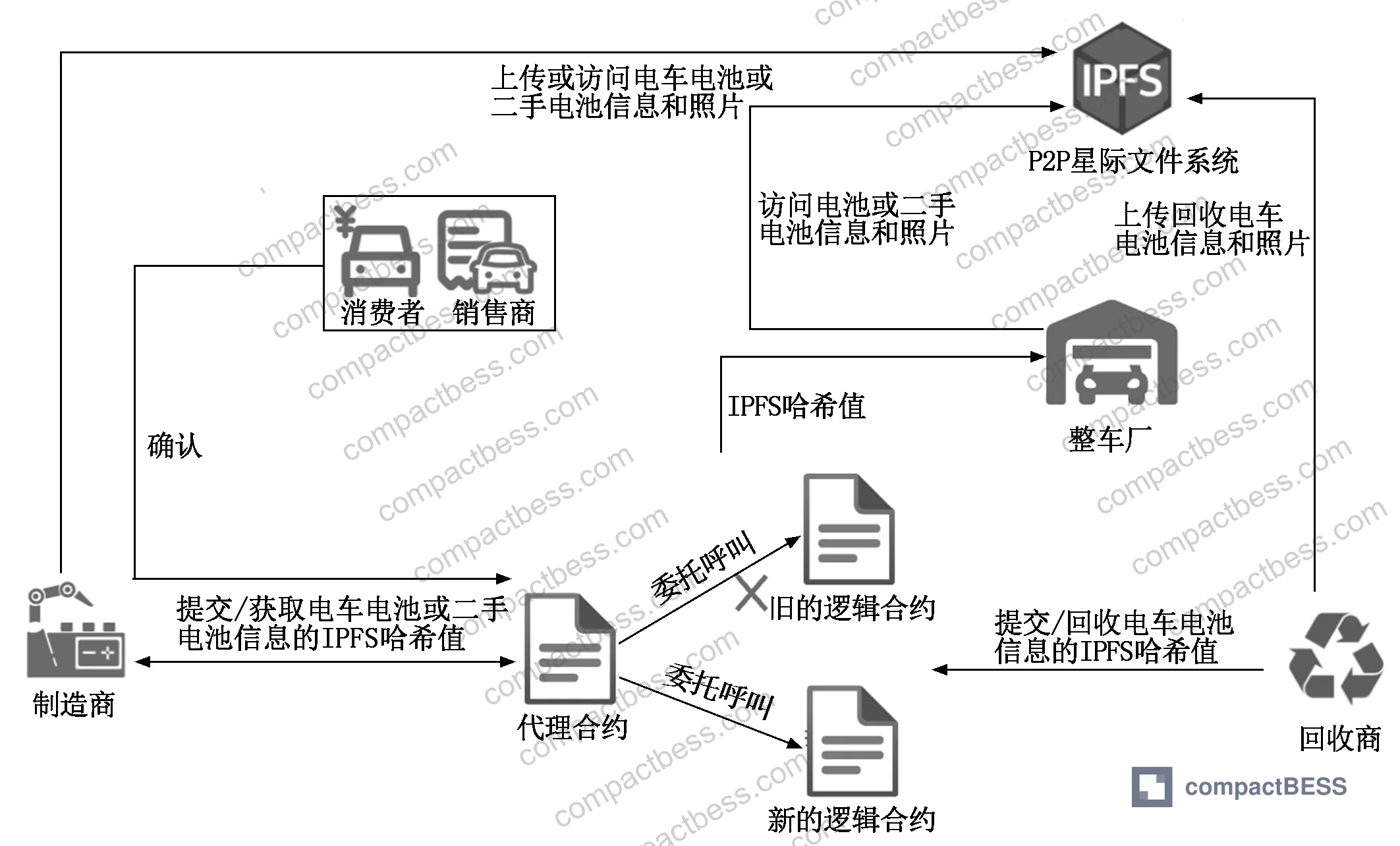
The research model tested here used a five-state data chain — PQ_Submitted, ManufactureApproved, InUse, EndOfLife, UsedBattery — with state transitions enforced by smart contract logic. That five-state model maps directly onto the physical lifecycle events that procurement specs should be tracking: production, OEM integration, field deployment, retirement trigger, and recycler receipt. Each state transition in the test deployment consumed between 19,136 and 19,968 gas units, translating to execution costs of approximately $1.164 to $1.268 USD per transaction at average network rates — low enough that per-pack data logging is economically viable even for mid-volume production runs.
Pack-Level Data Architecture and Its Impact on Cell Selection Decisions #
Most procurement teams don’t realize that the cycle life and degradation data they request from suppliers at the qualification stage is only meaningful if it can be connected to individual pack histories in the field. A supplier can show you a cycle life curve from a lab sample — that’s table stakes. What the current generation of traceable battery systems requires is that the same data structure used during manufacturing (cell type, capacity, voltage, form factor, estimated range) follows the pack through deployment and is independently accessible at the recycler stage without depending on the original manufacturer’s cooperation.
The architecture tested here achieves this through IPFS hash values transmitted via smart contract functions. The manufacturer uploads cell production data — including battery capacity, voltage specification, cell type, physical dimensions, and range rating — to a peer-to-peer distributed file system. The IPFS system generates a unique content hash, which is then passed to the OEM via the SubmitManufactureInformationIPFS (SMII) function. At end-of-life, the recycler uploads inspection data via the SubmitUsedBatteryInformationIPFS (SUII) function, and the manufacturer retrieves it using the same hash-based access protocol. Neither party can alter the stored data unilaterally — the content-addressed storage model prevents that.
Honestly, most procurement teams over-specify the electrical parameters and under-specify the data architecture. A cell with a 3% higher capacity but no traceable production history is increasingly a liability in markets where battery passports are becoming mandatory.
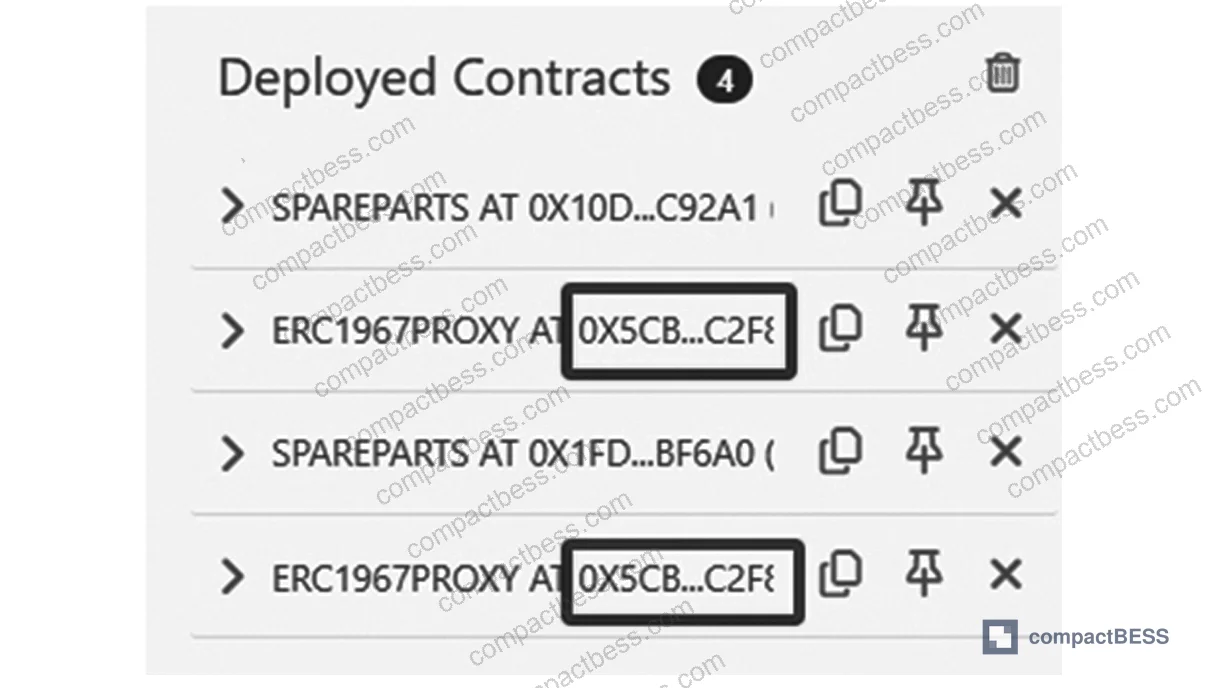
The upgradeable smart contract mechanism used here — specifically the UUPS (Universal Upgradeable Proxy Standard) proxy model — is important because it allows the contract logic to be patched without changing the contract address or losing stored data. In practice, this means a battery manufacturer can fix a data recording bug, add a new business module (like EV battery swap services), or update compliance reporting fields without invalidating existing pack records. That’s a significant operational advantage over static contract deployments, where a critical vulnerability might force a full re-deployment and data migration.
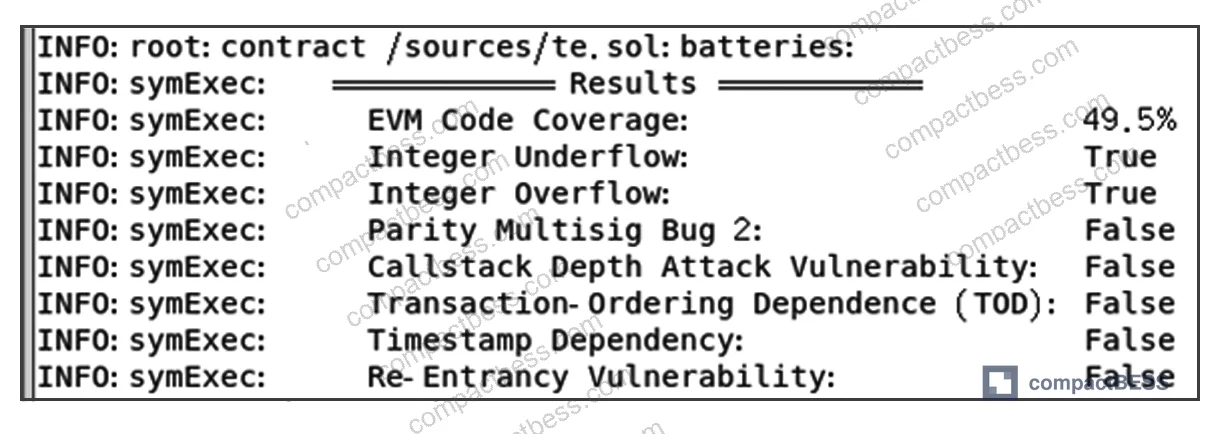
Security validation of the contract code used the Slither static analysis framework to check for common Ethereum vulnerabilities — reentrancy, timestamp dependency, and uninitialized variables — as well as Oyente for independent verification. The implementation used Solidity version 0.8.20, which includes built-in overflow and underflow protection, automatically reverting transactions when integer values exceed allowed ranges. Man-in-the-middle attack vectors were addressed through digital signature verification and TLS-encrypted transport for off-chain communications. Reentrancy attacks — where malicious actors repeatedly invoke a function like the battery recovery call before state updates complete — were mitigated using the check-effects-interactions pattern, updating internal state before triggering any external contract calls.
In supplier qualification, the single most common failure mode we see in blockchain-adjacent battery traceability claims is that suppliers have blockchain-sounding documentation systems but no actual on-chain state transitions. Three of five suppliers evaluated in a recent qualification round could provide PDF traceability reports but could not demonstrate a single verifiable on-chain transaction hash tied to a specific pack serial number. That distinction matters enormously when your downstream customer is asking for battery passport documentation.
Practical Guidance for Buyers #
At compactbess.com, we work with global OEM buyers and energy storage integrators who are increasingly asking about traceability requirements as part of their cell format selection process — and the honest answer is that format and data architecture need to be co-specified, not treated as separate decisions. If you’re sourcing cylindrical 21700 packs for a portable power station or prismatic LFP modules for a stationary BESS installation, the cell format affects not just the pack’s electrical behavior but its compatibility with upstream and downstream data systems.
From a practical standpoint: request IPFS hash logs or equivalent content-addressed data records from your supplier for at least one production batch before placing a volume order. Ask them to demonstrate a state transition record — from manufacture through final inspection — with a verifiable on-chain or cryptographically secured log. If they can’t do that for a pilot batch, they won’t be able to do it for 10,000 units when your compliance team needs documentation.
Pay particular attention to IEC 62619:2022 Safety requirements for secondary lithium cells and batteries compliance documentation — specifically whether the compliance records are static PDFs or dynamically linked to serialized pack data. Static PDFs are easy to fabricate. Linked records tied to a specific pack serial number and production timestamp are not.
For stationary energy storage installations, NFPA 855 Standard for the Installation of Stationary Energy Storage Systems increasingly requires documentation trails that trace back to cell-level manufacturing data. Your cell format selection should account for whether the chosen format supports this level of granularity.
Additionally, buyers targeting European markets should verify supplier familiarity with EU Battery Regulation 2023/1542, which mandates battery passport infrastructure for industrial and EV batteries — making on-chain or cryptographically secured traceability not a nice-to-have but a legal requirement.
Need help identifying qualified suppliers for traceable battery packs with documented lifecycle data systems? Talk to our sourcing team →
Supplier Qualification Questions #
- Can you provide an IPFS hash value or equivalent content-addressed record for a production batch, demonstrating that cell capacity, voltage specification, cell type, and physical dimensions are stored in a tamper-evident distributed file system?
- What is the per-transaction execution cost (in gas units) for your smart contract state transitions, and can you show that your SMII and SUII functions execute within 20,000 gas units per transaction — consistent with validated deployment benchmarks?
- Has your smart contract implementation been validated against reentrancy, integer overflow, and timestamp dependency vulnerabilities using static analysis tools such as Slither or Oyente, and can you provide the output reports?
- Do you use a UUPS or equivalent upgradeable proxy contract model that preserves the contract address and historical data after logic updates, and can you demonstrate a completed upgrade cycle without data loss?
- Can you demonstrate a complete five-state lifecycle record — from production submission through end-of-life recycler receipt — for at least one serialized pack, with each state transition cryptographically linked to the pack’s unique identifier?
Sourcing Checklist #
- ☐ Supplier can provide IPFS content hashes tied to specific pack serial numbers for at least one production batch, not just static PDF traceability reports
- ☐ Smart contract functions (SMII and SUII) execute at or below 19,968 gas units per transaction, verified against deployment cost benchmarks
- ☐ Contract code has been audited against Ethereum vulnerability categories including reentrancy, timestamp dependency, and uninitialized variables using Slither or equivalent static analysis framework
- ☐ Implementation uses Solidity 0.8.0 or higher (specifically 0.8.20 preferred) to ensure native overflow/underflow protection with automatic transaction reversion
- ☐ Supplier uses a UUPS or equivalent upgradeable proxy model — confirmed by demonstrating that the proxy contract address remains unchanged after at least one logic contract upgrade
- ☐ Battery production data uploaded to distributed storage includes all six required fields: cell capacity, voltage specification, cell type, physical dimensions, range rating, and production timestamp
- ☐ Supplier documentation demonstrates compliance with IEC 62619:2022 through dynamically linked per-pack records rather than batch-level static certificates
- ☐ For EU-bound shipments, supplier can demonstrate awareness of EU Battery Regulation 2023/1542 battery passport requirements and has a defined roadmap for compliance
Key Specifications Table #
| Parameter | Recommended Value | Verification Method |
|---|---|---|
| SMII function execution cost | ≤19,136 gas units (slow) / ≤19,968 gas units (average) | Deploy test transaction on Ethereum testnet; inspect gas consumed in transaction receipt |
| Slow execution cost per transaction | ≤$1.164 USD at $0.00006083/gas | Calculate from gas units × slow rate; verify against deployment cost table |
| Average execution cost per transaction | ≤$1.268 USD at $0.00006348/gas | Calculate from gas units × average rate; verify against deployment cost table |
| Smart contract Solidity version | ≥0.8.0 (0.8.20 validated) | Review contract source code; confirm compiler version in deployment artifact |
| Lifecycle state transitions | Minimum 5 states: PQ_Submitted → ManufactureApproved → InUse → EndOfLife → UsedBattery | Request state transition log for a pilot pack; verify sequential enforcement |
| IPFS data fields per pack | Minimum 6: capacity, voltage, cell type, dimensions, range, production timestamp | Request sample IPFS hash; retrieve and inspect stored JSON payload |
| Proxy contract address persistence | Address unchanged after logic contract upgrade | Compare proxy contract address pre- and post-upgrade in testnet deployment records |
Can’t find a supplier meeting these specs? Submit your requirements and we’ll match you within 48 hours.
References #
Data source: Upgradeable Smart Contract Architecture for End-of-Life EV Battery Traceability and Recycling Chain Management, H. Zhao et al., Journal of the Electrochemical Society, 2025
Frequently Asked Questions #
What is the practical difference between a blockchain-based battery traceability system and a conventional serial number database?
A conventional serial number database is controlled by a single party — usually the manufacturer — who can edit, delete, or selectively disclose records. A blockchain-based system enforces immutability through distributed consensus: once a state transition is recorded on-chain (e.g., battery manufactured, battery sold, battery collected for recycling), it cannot be altered without network-wide agreement. For procurement teams, this means that a recycler’s condition report and a manufacturer’s original production spec are independently verifiable by any authorized party — without trusting any single intermediary.
Does cell format affect compatibility with blockchain traceability systems?
Yes, significantly. Cylindrical cells support unit-level laser marking and automated optical inspection at high throughput, making them the most compatible format for per-cell serialization. Pouch cells, with soft exterior surfaces and carrier-dependent assembly, are the most difficult to serialize reliably after pack assembly. This is increasingly a real procurement consideration as battery passport requirements under EU Battery Regulation 2023/1542 come into force.
What does the UUPS proxy model mean for a buyer evaluating a supplier’s data infrastructure?
It means the supplier can fix bugs or add new reporting fields — like EV battery swap records or updated compliance fields — without losing your historical pack data or changing the contract address. For a buyer, this translates to long-term data reliability: records created at first production remain accessible and linkable even as the underlying software evolves.
How do execution gas costs translate into practical per-unit data logging costs?
At validated benchmarks of 19,136–19,968 gas units per transaction and current network rates of approximately $0.00006083–$0.00006348 per gas unit, each data logging event costs roughly $1.16–$1.27 USD. That’s per state transition — so a full lifecycle covering manufacture submission and recycler receipt runs approximately $2.40–$2.55 USD in on-chain transaction costs per pack.
Is smart contract security validation a supplier qualification requirement I should enforce?
It should be. The two tools most commonly used for Ethereum smart contract auditing — Slither for static analysis and Oyente for symbolic execution — specifically target reentrancy vulnerabilities, integer overflow/underflow errors, and timestamp manipulation. A supplier who cannot provide Slither output reports for their contract code has not done the minimum security validation. That’s a disqualifying gap, not a minor documentation issue.
Published by compactbess.com Technical Team | Request a sourcing quote


